
Originally written November 25, 2022.
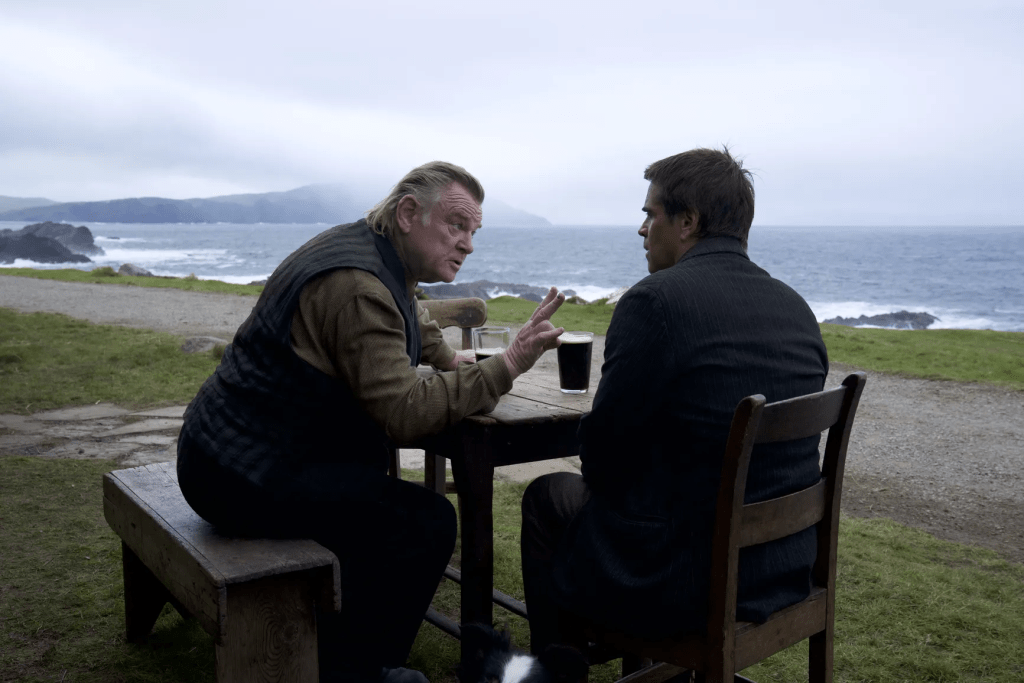
The sudden, unceremonious demise of a friendship between two men living out their days on an Irish isle–such is the setup for Martin McDonagh’s beautifully captivating and tragically humorous tale that unfolds like a slow-motion wreck with no wonderful resolution in sight.
Played to absolute perfection by Colin Farrell and Brendan Gleeson, the two men in question have for years been drinking buddies at the local pub on the fictional island of Inisherin. But Colm (Gleeson) suddenly turns cold, ignoring his friend Pádraic (Farrell) and refusing to be around him. The script doesn’t drag out the mystery for long: Colm reveals soon enough that he feels his friendship with Pádraic is wasting his time, time he would rather spend composing music that he might be remembered by when he passes. He comes across as frustratingly stoic in his conviction which immediately sends Pádraic into a state of distressing confusion, heightened all the more by Farrell’s intensely furrowed brows.
Where The Banshees of Inisherin succeeds is in tying together seemingly disparate individuals who nonetheless have a connection to one another through the small island community they call home. Numerous other characters weave themselves around Colm and Pádraic, all of them memorable. There’s Pádraic’s sister, Siobhán (wonderfully portrayed by Kerry Condon), who is steadfast and caring for her brother’s wellbeing yet longs for something greater in life on the mainland. There’s the island delinquent, Dominic (a squeamishly endearing performance from Barry Keoghan), who wears the pain from his abusive father–also the sole policeman on the island–quite literally on his face, and who plainly yearns for a deeper relationship, and perhaps a clearer sense of belonging, than what he receives at home. Others who enter the picture in smaller roles leave no less of an impact on the tapestry–the amusing barkeep and one of the regulars who seems to repeat everything he says; a local musician who befriends Colm but is sent away under comical circumstances by a resentful Pádraic; the delightfully grim Mrs. McCormick, who is lent such a deathly air by Sheila Flitton that her very presence seems to suck the air out of the room.
One of the most important bits of context for the events playing out on Inisherin is the backdrop of the Irish Civil War, which never reaches the island’s shores but still makes itself seen and heard through distant explosions. The war doesn’t offer any sort of meaningful political division among the island’s residents, but instead contributes to an overall feeling that Inisherin exists almost out of time and place; hundreds are dying in the mainland, yet the falling out between Colm and Pádraic, and the way it reverberates through their community, feels grand in scale. It’s an almost discomfiting reality that Pádraic’s loneliness, his mournful demeanor as he watches Colm spending time with new friends instead of him, feels more biting than death and destruction happening just out of sight.
And indeed, every time The Banshees of Inisherin treats the viewer to one of many gorgeous shots of the island one can’t help but feel utterly engrossed in such a specific time and place. The wide open terrain, sharp cliffs, and dark oceans stretching out into a void of encircling fog lend an otherworldly air to Inisherin. We feel this vast emptiness twofold: it’s an environment that’s particularly conducive to Pádraic’s desperate soul-searching, paradoxically suffocating despite the enormity of its beauty, yet grand enough to feel completely lost in; and it’s where dreamers like Colm and Siobhán feel the most unfulfilled.
What is ambition in this small community? The most stunning scene in The Banshees of Inisherin occurs when Pádraic confronts Colm over this idea. Pádraic, who has accepted for himself a simple life taking care of animals, cannot conceive of Colm’s desire to produce a great work to be remembered by at the expense of his friend. To Pádraic, simply being nice is all a person needs. “Do you know who we remember for how nice they was in the 17th century?” Colm asks. “Absolutely no one. Yet we all remembered the music of the time.” It’s a scenario no one relishes, that moment when one realizes just how woefully incompatible they are with someone they cared about.
 Nate Andrews
Leave a comment