Originally written February 24, 2025.
During that first summer of the COVID-19 pandemic I began delivering Uber Eats on my bike in the city of Philadelphia as a way to earn some money on the side and get a little exercise. Despite the broader, grim circumstances of that year I think back fondly on those miles pedaling through Point Breeze and Center City and Fairmount, dropping off bags of Chipotle and cups of coffee that hopefully didn’t spill too badly in my insulated backpack while dodging traffic and construction sites.
Watching protagonist Ming Ding (Charles Jang) ferry Chinese food through the streets of New York City in Take Out is a bit of a nostalgic time capsule for me, though what’s really interesting about this documentary-style film is that it captures the disconnected, impersonal nature of food delivery that persists even as the times change. Nearly every lunch order I dropped off during that summer was a contactless delivery wherein I never once saw the customer, and only rarely did I ever hear from them (the occasional “Thanks!” delivered via text).
In 2004, Ming sees every single customer upon delivery out of necessity—payment is made in person with cash, not over a mobile app. And yet almost none of these deliveries involve eye contact or any pleasantries, save for some very forced and awkward one-sided attempts at conversation that go nowhere. Ming doesn’t speak any English, and it doesn’t take long for many of his customers to adopt the very obvious and patronizing “I’m talking to an immigrant who doesn’t understand me” voice. It becomes clear that there is no more connection between Ming and these customers than what I felt dropping off a bag of mostly-warm food on a stoop and cycling away.
But there are hints of a more personal human experience to be had in the early-aughts food delivery business. Sean Baker and co-director Shih-Ching Tsou delight in the realism of their setting, filming at an actual Chinese restaurant during actual work hours. They showcase not just the talents and techniques of the cook (Justin Wan), but also the steadfast command of Big Sister (Wang-Thye Lee), the manager, cashier and order taker who confidently handles demanding customers like a captain leading a ship through rough waters. Cash is handled and passed back and forth and meticulously counted, a relic of the pre-NFC payment era. There’s a kind of warmth that’s captured in the tight confines of the kitchen even as it gets busier and noisier, and when rain begins pouring down over New York City and Ming is confronted by increasingly frustrated and impolite customers the restaurant begins to feel more and more like a safe haven.
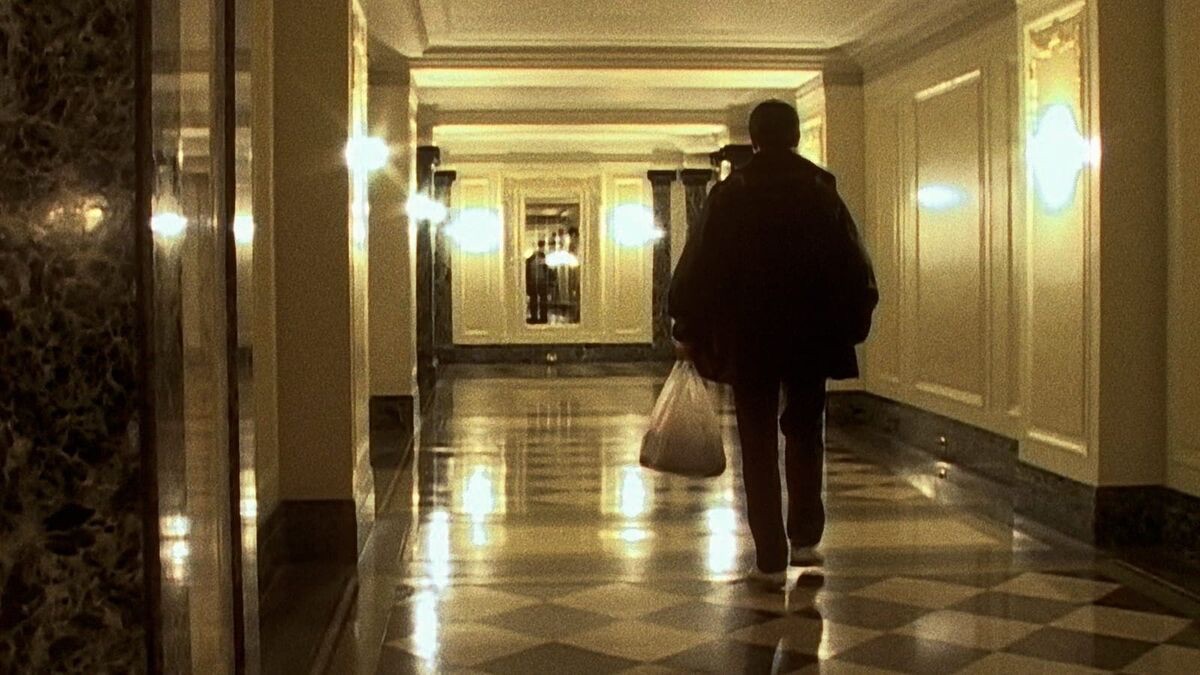
And indeed, this cramped kitchen environment, with the humming of its well-worn equipment and overhead lights and what I can only assume is an intoxicating mixture of culinary aromas, ends up contrasting in an unexpected way with the nondescript apartment hallways that Ming traipses down and the dull, heavy doors that denote a person’s living space. These plain spaces are not designed to be seen or entered by the public but they are where Ming must go to make his money, treading uncomfortably close to the private place where a stranger lays their head to sleep at night. Who is going to answer the door? Will they be wearing clothes? Are they going to be the worst person I meet today or unremarkable? The one time that Ming ends up inside one of these apartments due to confusion with the delivery feels like an unintended invasion. I have felt this, too, being asked to enter someone’s home to bring an order directly to their kitchen, a small voice in my head wondering, “They’re definitely not going to kill me, right?” Such is the life of dispassionate food delivery.
Take Out wraps up in just 88 minutes, but by the time the staff closes shop and finally head home it feels like an entire work shift has passed. It’s hard to believe that they will return to the kitchen the next morning to do it all again.
 Nate Andrews
Leave a comment