Originally written May 15, 2025.
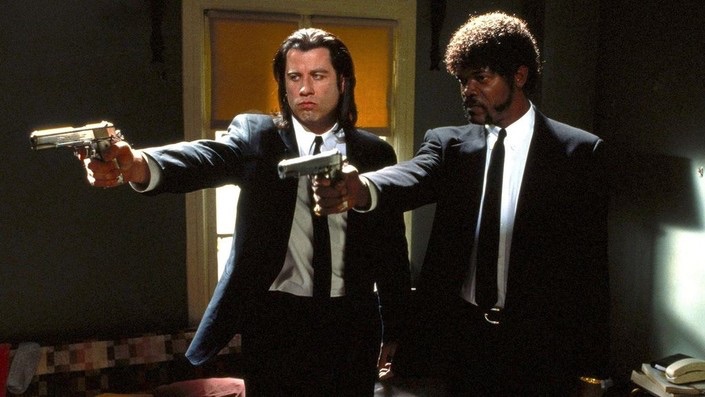
I first watched Pulp Fiction a decade or more ago during my Tarantino discovery phase that served as a kickstart to my dormant love of film, left behind after my childhood but waiting to be rekindled. I didn’t remember much from that first viewing, save for the iconic cheeseburger-laden “say ‘what’ again” scene that I was already familiar with thanks to 2000s Internet memes and clips that I viewed on repeat while cackling. What was this ridiculous movie that featured Mace Windu (probably my only Samuel L. Jackson association at the time) conversing with a nervous man about fast food before delivering a biblical damnation? I had no idea movies could do this!
The gaps in my memory of Pulp Fiction meant that this theater viewing felt like discovering the film again for the first time, only on a much grander and impressive scale, and it was here that it was firmly cemented for me as an all-timer. It was most immediately noticeable in the music, which dances and grooves so much harder on cinema speakers than through whatever TV or headphone setup I was using the first time around. The title sequence is a perfect tone-setter, hitting you with the fast and furious “Misirlou” before suddenly switching into Kool & The Gang’s “Jungle Boogie” without even a scene transition to go along with it—at least not immediately. It’s an early lively moment of surprise in a film filled with such moments.
Though each of the film’s vignettes do overlap in one way or another, the out-of-order narrative arrangement keeps you guessing. And even within these vignettes there are unexpected turns, anchored by Tarantino’s now-characteristically witty and animated dialogue, to say nothing of the director’s confident long takes and knack for steadily following characters as they make their way through a scene–the iconic dance between Vincent and Mia is an obvious highlight, but I also love the way the camera tails Vincent as he moves through Jack Rabbit Slim’s, drinking in the artificial, self-referential 1950s atmosphere.
I often think of “vibes” movies, the sort of films that tell a story but are perhaps more noteworthy for their mood and tone–some of my favorites that I’d ascribe to this are Paris, Texas (1984) and Chungking Express (1994). Is Pulp Fiction a vibes movie? What are the vibes? Trashy fun? Crazed exploitation? Excessive, overbearing snickering with a wink and a nod? I’m not sure I could place it either way, but I know that I had a tremendous time reliving this on the big screen and I’m already sorta dying to watch it again.
 Nate Andrews
Leave a comment