Originally written May 31, 2025.
With Paris, Texas (1984) I was really taken by Wim Wenders’ meditative treatise on desert soul searching, patient with its character work and replete with Robby Müller’s rich naturalist photography. It’s impressive that three years later Wenders would deliver an even more poetic and decidedly chillier Cold War-era Berlin story, filmed mostly in black and white at the hands of Henri Alekan. The result is a very different film but one that is still unmistakably Wenders.
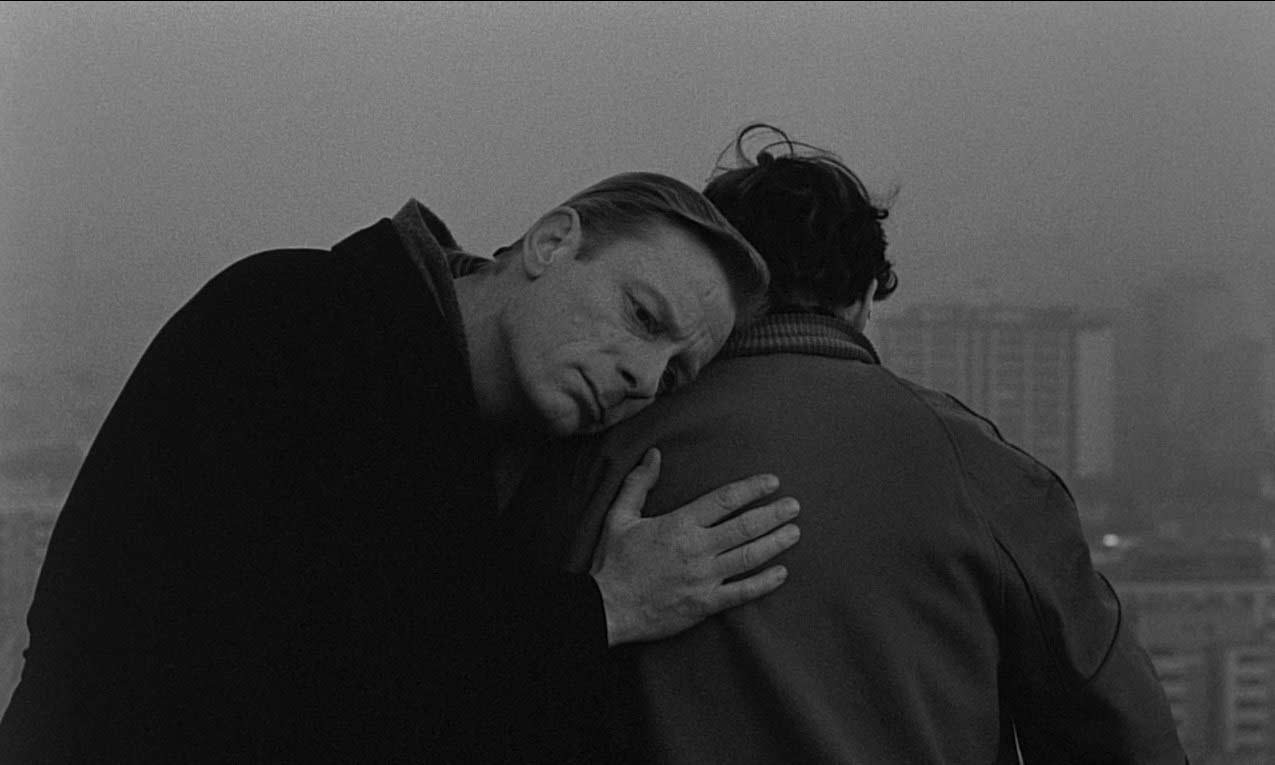
In Wings of Desire (1987), two angels bear witness to the internal struggles and worries of the citizens of Berlin, and when one of them falls in love with a trapeze artist he makes the decision to forsake his angelic immortality and become human. The gentleness with which the angels take in these inner monologues is a thing of beauty in part because of the way the camera floats through each scene, the vocalized thoughts of individuals swimming in and out of our ears, capturing life’s anxieties and trepidations. It’s also because of the empathetic nature of the angels, who, unseen to everyone but children, tenderly rest their hands and heads on the shoulders of the downtrodden.
It’s a film loaded with spiritually profound moments—not the least of which is the sheer idea of an angel, having had centuries to witness firsthand the suffering of mortal beings, choosing to embrace that life for himself in spite of it all—though crucially it never once mentions God in any capacity. Wrote Michael Atkinson in 2009: “It has beguiled the Wenders aficionado as reliably as it’s absorbed the spiritually hungry civilian, the rogue filmhead, the bookish square, and the nondenominational seeker.” In short, a film that “could be all things to all people.” I like to think of Paris, Texas and Wings of Desire as companion pieces. One, a sunburned malaise over an individual’s identity lost to the wind and their search for meaning; the other, a society’s collective distress fueling an immortal being’s desire to create their own personhood. Across both films we might find a common ground: to suffer and experience hardship is to experience being a human on this earth, and no one is more human than the people in these films.
 Nate Andrews
Leave a comment