Originally written September 8, 2025.
“There are few things more fundamentally encouraging and stimulating than seeing someone else die. You see, Colonel, troops are like children. Just as a child wants his father to be firm, troops crave discipline. And one way to maintain discipline is to shoot a man now and then.”
The First World War is easy fodder for the sort of nihilistic and absurd humor that would define some of my favorite antiwar material like Blackadder Goes Forth (1989), and you can see the beginnings of the scenery-chewing folly that would define Kubrick’s genius 1964 film Dr. Strangelove in Generals Mireau (George Macready) and Broulard (Adolphe Menjou), who for the entire duration of this film seem to be but a moment away from developing the same smirk and twinkle in their eyes as Stephen Fry’s General Melchett as they nonchalantly discuss the slaughter and execution of their own men.
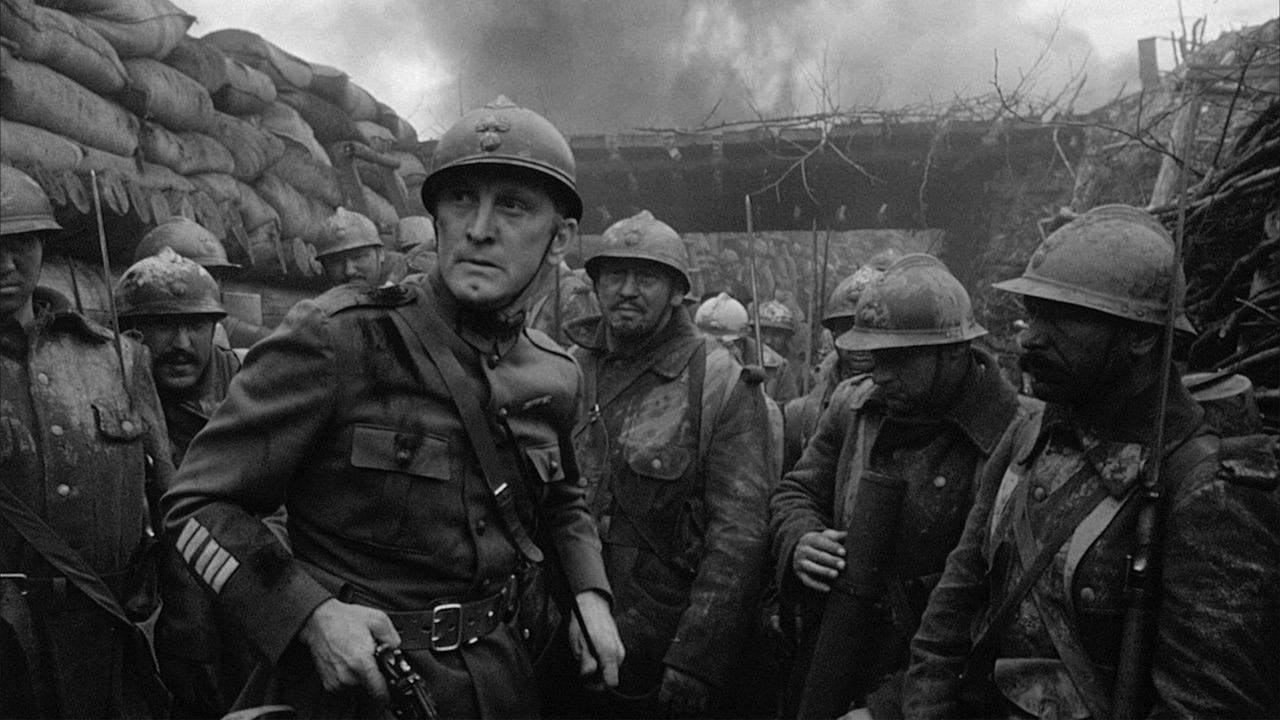
It’s maybe a well-trodden path for World War I fiction nowadays but it nonetheless remains compelling thanks to the hallmark tracking shots and long takes of the camera steadily moving through trenches as artillery explodes just a few meters away. The scene of the men going over the top is pretty harrowing, as Colonel Dax’s (Kirk Douglas) shrill whistle to signal the advance threatens to irreparably damage the ears. Men scramble across the lunar hellscape of craters, bodies, and barbed wire as artillery and machine guns go open season on them, and the cinematic scale of the attack is impressive.
Kubrick’s framing and direction are excellent as to be expected, but Gerald Fried’s understated score also goes a long way to building the tension that defines some of the film’s best moments. The use of stark military snares, especially during the film’s climactic execution scene, combined with the steady and confidant camerawork make for an uncomfortably tense atmosphere.
Paths of Glory isn’t interested in the overall war effort or even the alleged tactical advantage of the German position that these men are tasked with taking, focusing instead on the brutal disconnect between command and infantry in one of this planet’s worst conflicts. Despite the specifics of the setting, it’s not difficult to see the narrative beats of Paths of Glory applied to any other conflict. While World War I was notoriously profound in the churning of human life for minimal gains, any war in which people are sent to die by others–which is to say, all of them–carries similar experiences to what’s portrayed here: the confined, terrifying destruction and maiming experienced by those on the ground, the far-away comforts enjoyed by those separated from the action by rank or position, the impossibility of making sense of unfair impending death.
World War I was a nasty collision of old world thinking about the glories of battle and new world industrial warfare. As General Mireau so lavishly puts it:
“The men died wonderfully.”
 Nate Andrews
Leave a comment