Looking through my list for 2025 I’m struck by how many films made the cut that deal with existential issues around death, meaning, and so on and so forth. Not sure what that says about me. (I have a pretty good idea, actually. I swear it’s not negative though!)
I made a pretty conscious effort to dive into films this year that dealt with the extremes of human life in some way or another. Disease, war, solar apocalypses, patient soul-searching, romantic yearning, anxieties of all kinds, it all struck a chord with me. These are those movies, beginning with ten honorable mentions that could’ve made the list but were just barely squeezed out. It’s an honor to be nominated!
I also explored (not quite fully) the filmographies of Stanley Kubrick, Sean Baker, and Wim Wenders, who all make numerous appearances in my list this year. It’s part of a larger effort of mine to check out bodies of work from specific individuals who I feel particularly inspired by or curious about. I’m hoping to do quite a bit more of that in 2026. Plus, I got further into the Criterion Challenge this year than in years past, which led to several films showing up here as well. Will 2026 be the year I finally complete the whole thing? Let’s say yes!
Some of the text for the films in this list is copied over from my reviews when I watched them, with some edits here and there. The list is meant to not only be an encapsulation of my favorite movies from this year, but also of my words about them. I’m looking forward to continuing to practice my film writing in 2026 and beyond!
Honorable Mentions:
10. Risky Business Directed by Paul Brickman 1983
While Repo Man–the other Reagan-era satire that landed on my list this year–planted itself in punky surrealism, Risky Business remains grounded in the realm of white suburbia where Ivy League schools, Porches, and simmering sexual energy make up the trinity of existence. At first blush this premise of a high school senior having the house to himself, driving his daddy’s expensive car and hooking up with girls, seems like the setup for a stock standard teen film, but Paul Brickman, aided by the indelible German electronic group Tangerine Dream, crafts a dreamy and at times hypnotic coming-of-age story–the beautiful Chicago cityscape opening and the terrific train sequence provide a wonderful contrast to the film’s humor. Really enjoyed this one.
9. Ballerina Directed by Len Wiseman 2025
Pretty good bit of John Wick DLC. I definitely expected a more stylish film after some of the striking marketing material, and had hoped that it would more strongly combine the brutal Wickian precision with the skillful acrobatics of ballet to create something unique. Alas, aside from the flashy requisite night club sequence Ballerina felt mostly like standard Wick affair—lots of headshots, stabbing, and throwing dudes over one’s shoulder, though with quite a bit more prop work here. This still makes for some great action movie-watching, mind you, if a bit predictable. Things get a little funny and a little weird when John Wick’s role is treated as some kind of tongue-in-cheek, self-referential thing; I can’t decide if it was a good bit of humor or just self-indulgent. Maybe a little of both.
8. Heart Eyes Directed by Josh Ruben 2025
Hitting play on a horror film on Netflix with little foresight always feels like a fast track to a real time waster of a movie but I was pleasantly surprised by how breezy and effortlessly funny Heart Eyes is. Olivia Holt and Mason Gooding cruise through this unique blend of slapstick comedy and gruesome slasher kills without missing a beat, and quality editing and effects keeps the action feeling visceral. I can see myself returning to this one.
7. Hamilton Directed by Thomas Kail 2020
What I saw when I watched Hamilton was a sensationally directed, written and performed tale about legacy and the ambitions that drive us to do the things we do, one that is quite beautiful and that frequently jostles between funny and engaging historical bits and deeply touching moments of loss and heartbreak. What I understand Hamilton to be after the fact is likely to evolve over time. The zeitgeist mostly missed me, and so I’m only really becoming exposed to the praise and criticisms of the production years after the fact. I think everyone is right about Hamilton, whether they’re lambasting it for glamorizing the founding of the United States while ignoring many of its ugly realities, or obsessing over its catchy tunes. That’s a frustratingly centrist position to take, but hey. I had fun with Hamilton this year. I’ll be bummed about it later.
6. The Shallows Directed by Jaume Collet-Serra 2016
There’s always room for a decent shark movie, isn’t there? I was especially interested in checking out Jaume Collet-Serra’s survival film after being pretty impressed with last year’s Carry-On. As it turns out, this is a totally competent and adequately thrilling one of those, unfolding inside one of the Apple TV ocean screensavers.
5. The Others Directed by Alejandro Amenabar 2001
This is an effective and engrossing ghost story with what is for sure the best Nicole Kidman performance I’ve seen. Loved the minimalist Gothic style and excellent sound design and score from director Alejandro Amenábar.
4. All That Jazz Directed by Bob Fosse 1979
It was a nice spot of coincidence that my local theater would be showing All That Jazz right after I watched the 1977 truck horror film Sorcerer and started feeling like I could use more Roy Scheider in my life. Luckily I had waited this long to see it; this is a film that definitely benefits from the pop of the big screen.
Admittedly I knew nothing of director Bob Fosse’s life prior to today, and I really do think that knowing some of the autobiographical context of All That Jazz is a key component to appreciating how wild this thing really is. It’s treatment of sad existential pageantry demands a very different kind of performance than what I’ve seen from Scheider till now—it’s hard to believe this is Police Chief Brody!—and he commits fully and excellently to the role. He’s backed by Fosse’s terrific direction and the much-lauded editing from Alan Heim that weaves the tale in and out from the real world to protagonist Joe Gideon’s inner monologues and deathbed dream sequences, culminating in a marvelously bleak and unforgettable final sequence.
3. Princess Mononoke Directed by Hayao Miyazaki 1997
I did a bit of catching up on Studio Ghibli films this year and Princess Mononoke was my favorite of the batch. I loved the visuals, the storytelling, the setting, the characters. Just a strong, captivating movie all around.
2. Paddington (1 and 2) Directed by Paul King 2014 / 2017
My goodness, these films are so unbelievably charming and funny. I knew nothing of Paddington, so I had no real expectations going into these and was wildly surprised by how fun they are.
1. The Apartment Directed by Billy Wilder 1960
You gotta love the one-two Wilder-Lemmon punch of Some Like It Hot (1959) and The Apartment, coming out just one year after the duo blew the doors off with their Tony Curtis and Marilyn Monroe co-starring comedy. The Apartment leans further into the drama territory than did its predecessor. It is a superbly well-constructed film with a natural sense of pacing and an organic score that expertly matches each scene. Each of its layers and the way they come together—the white collar worker climbing the corporate ladder by letting company executives use his apartment to cheat on their wives, the elevator operator who endures workplace harassment and finds herself as the next girl in line for a powerful company man, the boss who believes that everything he wants ought to simply fall into his lap simply because he willed it so—are a delight, the script and performances together telling a story that flows smoothly and believably from scene to scene. It’s just a terrifically engaging film from start to finish and further cemented Jack Lemmon as one of my favorite actors.
And now, the list.
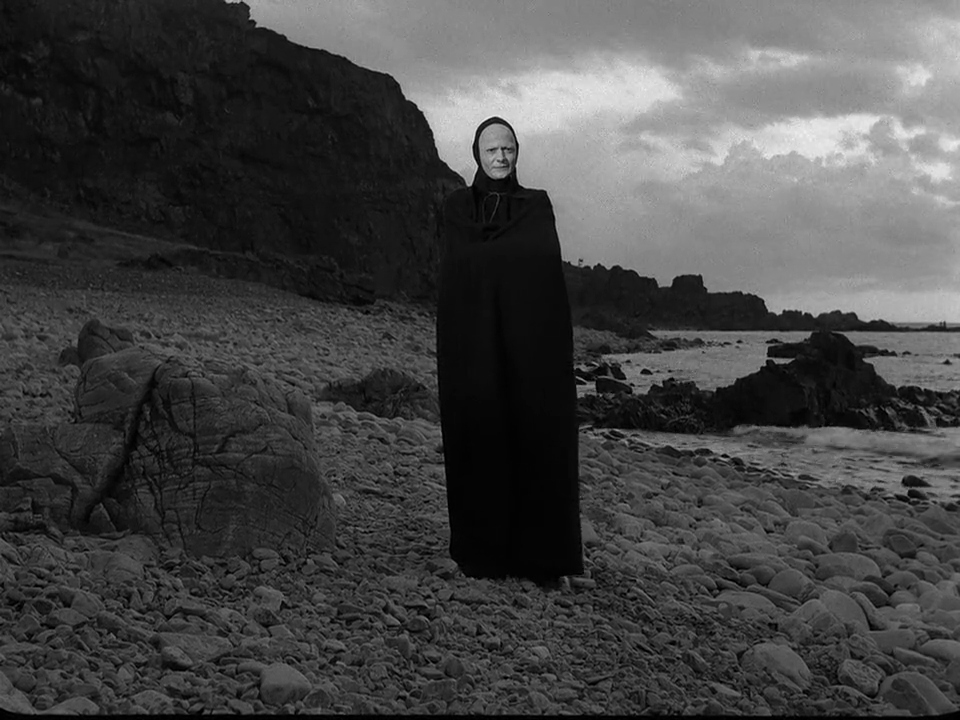
25. The Seventh Seal Directed by Ingmar Bergman 1957
“Faith is a torment. It is like loving someone who is out there in the darkness but never appears, no matter how loudly you call.”
You’ve returned home after fighting a holy war in a foreign land, likely believing that you’ve been doing God’s work, only to find your homeland ravaged by a historic plague. One world of devastation traded for another, from a Crusade so inhumane and violent that your squire has become bored of assaulting women in villages, to a once-familiar land brought to its knees by disease, where roving bands of self-flagellants pass through towns in parades of despair, demanding that everyone in earshot reckon with their impending doom. You try to believe that God is there in some capacity but your eyes fail to paint a reality where this could ever be possible. What else is there to do but challenge Death himself to a game of chess in order to buy yourself some time to ask an accused witch for the whereabouts of Satan—who else may know God in these times?—or perhaps to feast on fresh strawberries on a hillside in the joyous company of a performing troupe, a welcome distraction from your own internal collapse.
The Seventh Seal is noteworthy in part because it introduced me to Swedish filmmaker Ingmar Bergman, whose dreamy meditations on existence and the soul captivated me through this film and his same-year follow up, Wild Strawberries. It is a bleak and powerfully thoughtful exploration of a crisis of faith at the end of the line, with an unforgettable ending that feels equal parts sorrowful and mercifully conclusive. After so much spiritual disintegration, what better than for Death to take you hand-in-hand into the inevitable?
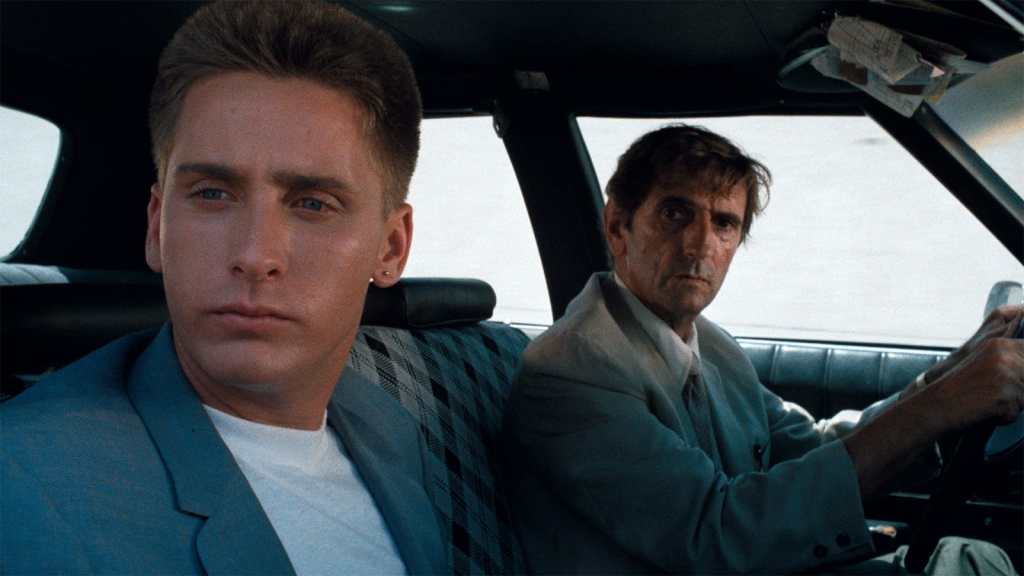
24. Repo Man Directed by Alex Cox 1984
“Look at those assholes, ordinary fucking people. I hate ‘em.”
Vicarious living for people who just want to listen to 80s punk, jack cars and drive them down the LA river, and sneer at all the ordinary people and say “fuck ’em”. Intriguingly weird and satirically, politically charged–not necessarily in the most profound way, but there’s enough of a bite that it feels like you’re watching something a least a little meaningful about a time and place–in this case, Regan-era America with its dead-end jobs, washed-out hippies and disgruntled war veterans, and the late teens and 20-somethings who have to grow up in their world.
When I watched this it was the first time I had seen the distinctly-faced Harry Dean Stanton in something outside of Alien, and his pitch-perfect performance as a coked-up repossession agent was so good that I couldn’t wait to see him again in Paris, Texas. I was also surprised how much I enjoyed Emilio Estevez in his role. I’ve never thought of him as much of an excitable presence but his inherently soft and somewhat detached demeanor worked well here. You can feel just enough of an edge coming out as he embraces the repo life, while still never quite shaking his newbie persona.
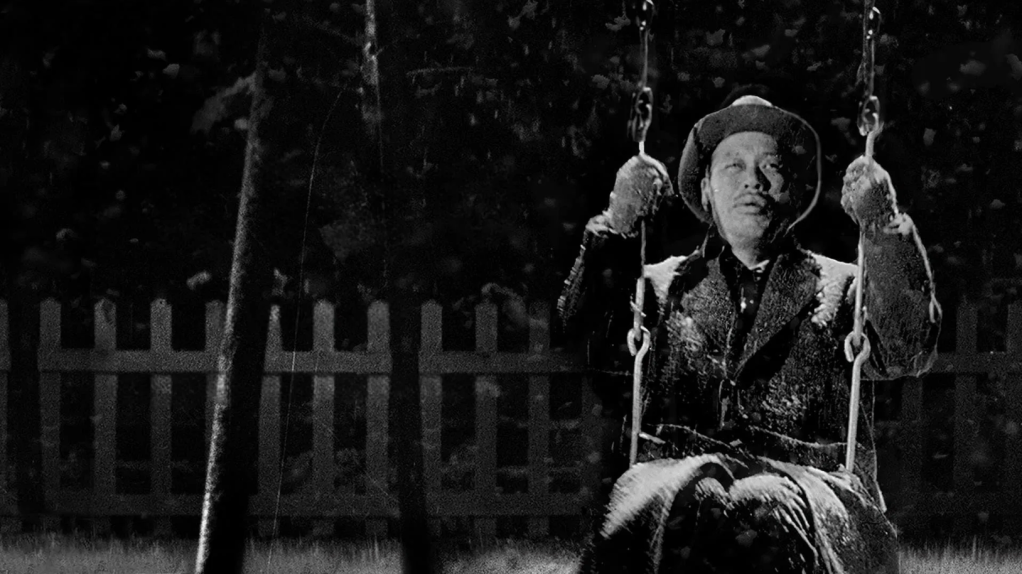
23. Ikiru Directed by Akira Kurosawa 1952
“I can’t afford to hate people. I don’t have that kind of time.”
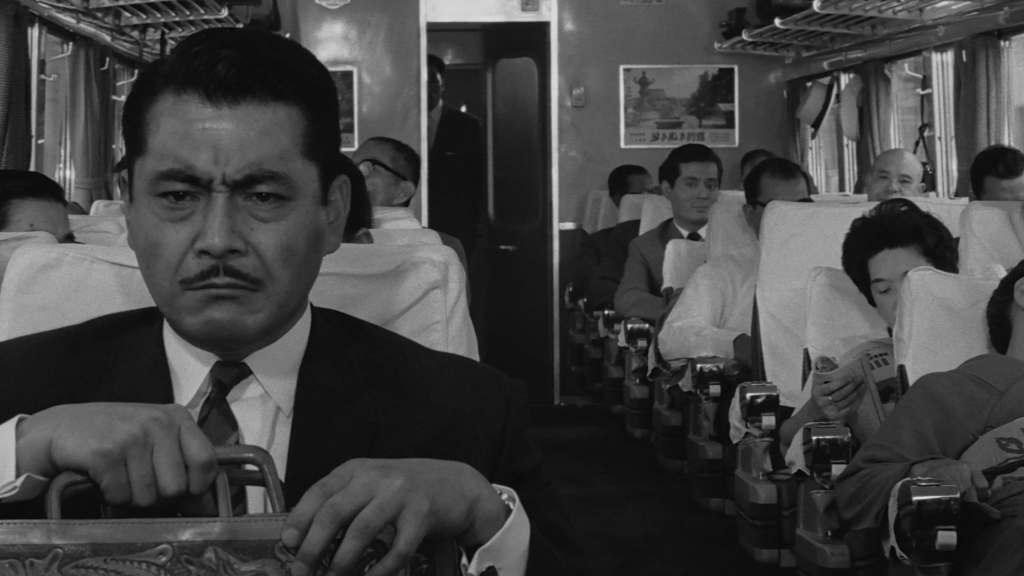
Probably the best portrayal of profound existential sadness I’ve seen, courtesy of the quiet and unassuming Takashi Shimura who was one of my favorite of the samurai in Kurosawa’s 1954 historical epic. Ikiru is a very different film, focused intensely on a man’s terminal cancer diagnosis and his reckoning with a life spent as a career man and not much else.
Shimura’s performance as Kanji Watanabe is a true exercise in down-on-your-luck despair. Kurosawa’s camera lingers uncomfortably long on Watanabe throughout the film as he hangs his head and mutters despondently through conversations, eyes welling up with tears or on the verge of doing so. Watanabe’s lamentations about his life spent working and feeling boredom, and his belief that it’s simply too late to do anything meaningful, is sure to leave a lasting impression on me, primed as I am for this sort of existential questioning.
His search for some kind of meaning in the six months he has left to live is well-sequenced, taking him through unsuccessful jaunts in night clubs and then into the presence of a young woman whose energy and love of life rejuvenates him. At the same time, Kurosawa explores Watanabe’s unfulfilling family life and the bureaucracy that instills dispassion and overcomplication of everything, two aggravating factors that practically suffocate him. Watanabe’s brute force overcoming of his workplace structure to fulfill a community’s need for a playground is a joyous celebration for him and us, so sweet it is to see him achieve what he thought would be impossible, though Kurosawa doesn’t let the moment slide without crashing a little bit of reality into it—the bureaucrats very slowly realizing that Watanabe was responsible for the playground agenda being pushed through, swearing that they will act honorable towards their communities going forward, and then immediately falling back into the same old habits is just one of the very real things on display here.
I admire the courage of Kurosawa and Shimura to bring such a difficult story and character to life. I mentioned in my brief review of The Curious Case of Benjamin Button (2008) that overly-sentimental stories of aging are an almost guaranteed miss for me due to the highly negative feelings they stir up—I guess I prefer my narratives about the irrepressible march of time to be couched in some crazy shit, à la X (2022). But to its credit, Ikiru plays it fairly straight, sticking with real people with real flaws facing real problems and reacting in real ways. Even with its protagonist managing to find some sort of release from his pain, it’s nevertheless a pretty harrowing watch.
22. Paris, Texas Directed by Wim Wenders 1984
“All he wanted to do was… sleep. And for the first time, he wished he were far away. Lost in a deep, vast country where nobody knew him. Somewhere without language, or streets.”
The slowest slow burn of a film I can remember seeing, two and a half hours of desert slide guitars and an aching sensation of time and identity lost to the winds. Paris, Texas flirts with being too sleepy for its own good—being my first Wim Wenders film probably contributed to the lethargy—but it really is a slow-rolling thing of beauty, unfolding in front of you like a montage of faded memories. It finds a way to dig into the soul, whether I was invigorated by its proceedings or not.
It’s a revelatory performance by Harry Dean Stanton. Who knew the Nostromo’s engineering technician could wear this much depth on his face and in his voice, portraying a man adrift within himself and in the vastness of the deserts of the western United States, trying to piece his family back together after he disappeared for four years. It’s all worth it in the end for his emotional confrontation with Jane (Nastassja Kinski), an extraordinary scene that single-handedly convinced me that I did, in fact, love this film.
21. Wings of Desire Directed by Wim Wenders 1987
“Sometimes I’m fed up with my spiritual existence. Instead of forever hovering above I’d like to feel a weight to tie me to Earth. I’d like, at each step, each gust of wind, to be able to say, ‘now’ and no longer ‘forever’ and ‘for eternity’.”
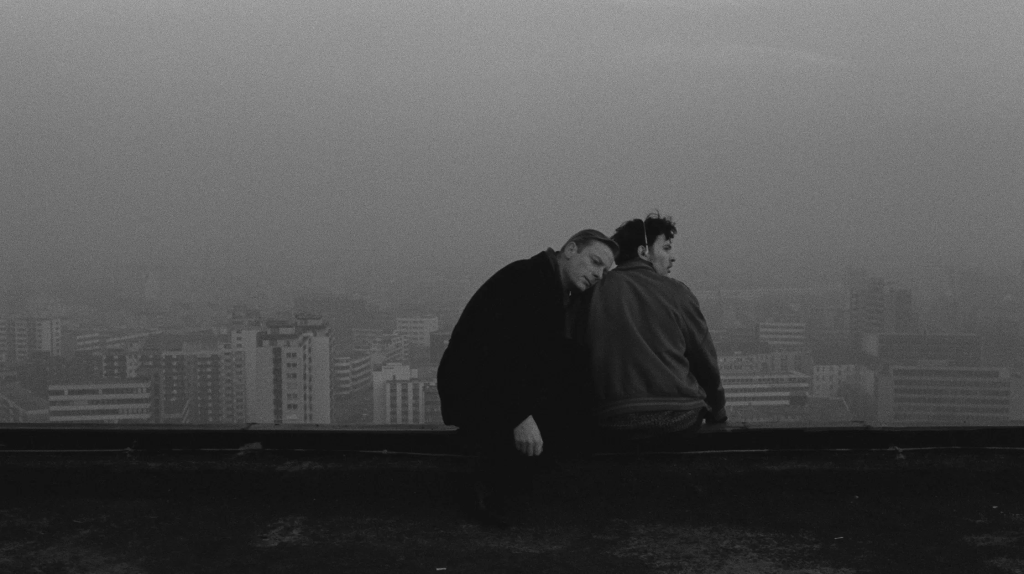
With Paris, Texas I was really taken by Wim Wenders’ meditative treatise on desert soul searching, patient with its character work and replete with Robby Müller’s rich naturalist photography. It’s impressive that three years later Wenders would deliver an even more poetic and decidedly chillier Cold War-era Berlin story, filmed mostly in black and white at the hands of Henri Alekan. The result is a very different film but one that is still unmistakably Wenders.
In Wings of Desire, two angels bear witness to the internal struggles and worries of the citizens of Berlin, and when one of them falls in love with a trapeze artist he makes the decision to forsake his angelic immortality and become human. The gentleness with which the angels take in these inner monologues is a thing of beauty in part because of the way the camera floats through each scene, the vocalized thoughts of individuals swimming in and out of our ears, capturing life’s anxieties and trepidations. It’s also because of the empathetic nature of the angels, who, unseen to everyone but children, tenderly rest their hands and heads on the shoulders of the downtrodden.
It’s a film loaded with spiritually profound moments—not the least of which is the sheer idea of an angel, having had centuries to witness firsthand the suffering of mortal beings, choosing to embrace that life for himself in spite of it all—though crucially it never once mentions God in any capacity. Wrote Michael Atkinson in 2009: “It has beguiled the Wenders aficionado as reliably as it’s absorbed the spiritually hungry civilian, the rogue filmhead, the bookish square, and the nondenominational seeker.” In short, a film that “could be all things to all people.” I like to think of Paris, Texas and Wings of Desire as companion pieces. One, a sunburned malaise over an individual’s identity lost to the wind and their search for meaning; the other, a society’s collective distress fueling an immortal being’s desire to create their own personhood. Across both films we might find a common ground: to suffer and experience hardship is to experience being a human on this earth, and no one is more human than the people in these films.
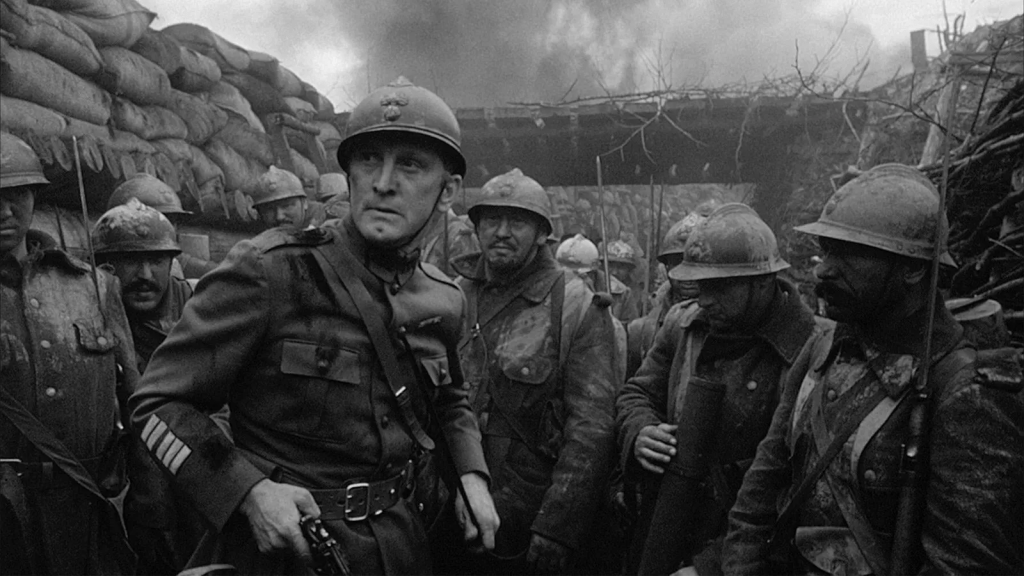
20. Paths of Glory Directed by Stanley Kubrick 1957
“There are few things more fundamentally encouraging and stimulating than seeing someone else die. You see, Colonel, troops are like children. Just as a child wants his father to be firm, troops crave discipline. And one way to maintain discipline is to shoot a man now and then.”
The First World War is easy fodder for the sort of nihilistic and absurd humor that would define some of my favorite antiwar material like Blackadder Goes Forth (1989), and you can see the beginnings of the scenery-chewing folly that would define Kubrick’s genius 1964 film Dr. Strangelove in Generals Mireau (George Macready) and Broulard (Adolphe Menjou), who for the entire duration of this film seem to be but a moment away from developing the same smirk and twinkle in their eyes as Stephen Fry’s General Melchett as they nonchalantly discuss the slaughter and execution of their own men.
It’s maybe a well-trodden path for World War I fiction nowadays but it nonetheless remains compelling thanks to the hallmark tracking shots and long takes of the camera steadily moving through trenches as artillery explodes just a few meters away. The scene of the men going over the top is pretty harrowing, as Colonel Dax’s (Kirk Douglas) shrill whistle to signal the advance threatens to irreparably damage the ears. Men scramble across the lunar hellscape of craters, bodies, and barbed wire as artillery and machine guns go open season on them, and the cinematic scale of the attack is impressive.
Kubrick’s framing and direction are excellent as to be expected, but Gerald Fried’s understated score also goes a long way to building the tension that defines some of the film’s best moments. The use of stark military snares, especially during the film’s climactic execution scene, combined with the steady and confidant camerawork make for an uncomfortably tense atmosphere.
Paths of Glory isn’t interested in the overall war effort or even the alleged tactical advantage of the German position that these men are tasked with taking, focusing instead on the brutal disconnect between command and infantry in one of this planet’s worst conflicts. Despite the specifics of the setting, it’s not difficult to see the narrative beats of Paths of Glory applied to any other conflict. While World War I was notoriously profound in the churning of human life for minimal gains, any war in which people are sent to die at the hands of others–which is to say, all of them–carries similar experiences to what’s portrayed here: the confined, terrifying destruction and maiming experienced by those on the ground, the far-away comforts enjoyed by those separated from the action by rank or position, the impossibility of making sense of unfair impending death.
World War I was a nasty collision of old world thinking about the glories of battle and new world industrial warfare. As General Mireau so lavishly puts it:
“The men died wonderfully.”
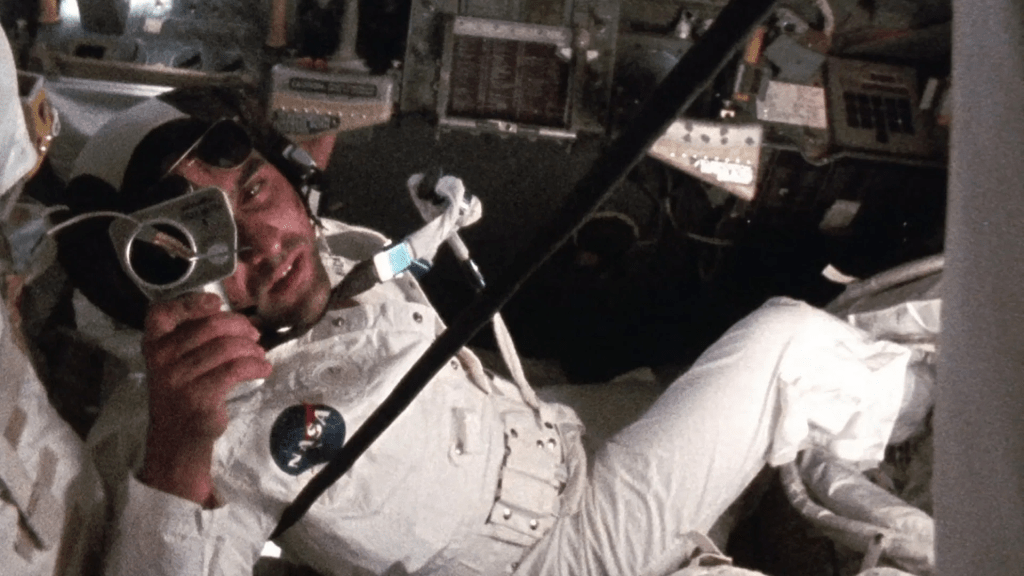
19. For All Mankind Directed by Al Reinert 1989
The extraordinary footage assembled for Al Reinert’s documentary on the Apollo moon landings can best be summed up by this mesmerizing quote from an astronaut who was lucky enough to set foot on the dusty surface of our beloved satellite:
“You just had to steal time now and then. You just had to stop chipping at a rock and figure out that bringing back a little bit of some kind of thought and feeling was as important as bringing another chunk of rock back. And not being a machine but being a human being you had to stop and say, “Do you know where you are and what you’re looking at?’ And try and take in, in those few moments of privacy, everything there is to take in in that moment.”
What makes For All Mankind unique is the manner in which it’s constructed, telling a narrative of humanity’s journey to the moon by blending together footage from several different Apollo missions and presenting them in an overarching chronological order. So we see the crews of different missions preparing for their journey, then we join them as they hurtle through space, then gaze in wonder as the crews hop around on the moon. At no point does the documentary indicate which Apollo mission you’re watching, nor does it name the astronauts speaking until the credits roll, a decision that at first can make for a rather confusing watch until you realize it’s real purpose of presenting the moon landings not as the accomplishment of a select few individuals but as a victory for the human spirit and our yearning for adventure and discovery within the cosmos.
18. Take Out Directed by Sean Baker 2004
During that first summer of the COVID-19 pandemic I began delivering Uber Eats on my bike in the city of Philadelphia as a way to earn some money on the side and get a little exercise. Despite the broader, grim circumstances of that year I think back fondly on those miles pedaling through Point Breeze and Center City and Fairmount, dropping off bags of Chipotle and cups of coffee that hopefully didn’t spill too badly in my insulated backpack while dodging traffic and construction sites.
Watching protagonist Ming Ding (Charles Jang) ferry Chinese food through the streets of New York City in Take Out is a bit of a nostalgic time capsule for me, though what’s really interesting about this documentary-style film is that it captures the disconnected, impersonal nature of food delivery that persists even as the times change. Nearly every lunch order I dropped off during that summer was a contactless delivery wherein I never once saw the customer, and only rarely did I ever hear from them (the occasional “Thanks!” delivered via text).
In 2004, Ming sees every single customer upon delivery out of necessity—payment is made in person with cash, not over a mobile app. And yet almost none of these deliveries involve eye contact or any pleasantries, save for some very forced and awkward one-sided attempts at conversation that go nowhere. Ming doesn’t speak any English, and it doesn’t take long for many of his customers to adopt the very obvious and patronizing “I’m talking to an immigrant who doesn’t understand me” voice. It becomes clear that there is no more connection between Ming and these customers than what I felt dropping off a bag of mostly-warm food on a stoop and cycling away.
But there are hints of a more personal human experience to be had in the early-aughts food delivery business. Sean Baker and co-director Shih-Ching Tsou delight in the realism of their setting, filming at an actual Chinese restaurant during actual work hours. They showcase not just the talents and techniques of the cook (Justin Wan), but also the steadfast command of Big Sister (Wang-Thye Lee), the manager, cashier and order taker who confidently handles demanding customers like a captain leading a ship through rough waters. Cash is handled and passed back and forth and meticulously counted, a relic of the pre-NFC payment era. There’s a kind of warmth that’s captured in the tight confines of the kitchen even as it gets busier and noisier, and when rain begins pouring down over New York City and Ming is confronted by increasingly frustrated and impolite customers the restaurant begins to feel more and more like a safe haven.
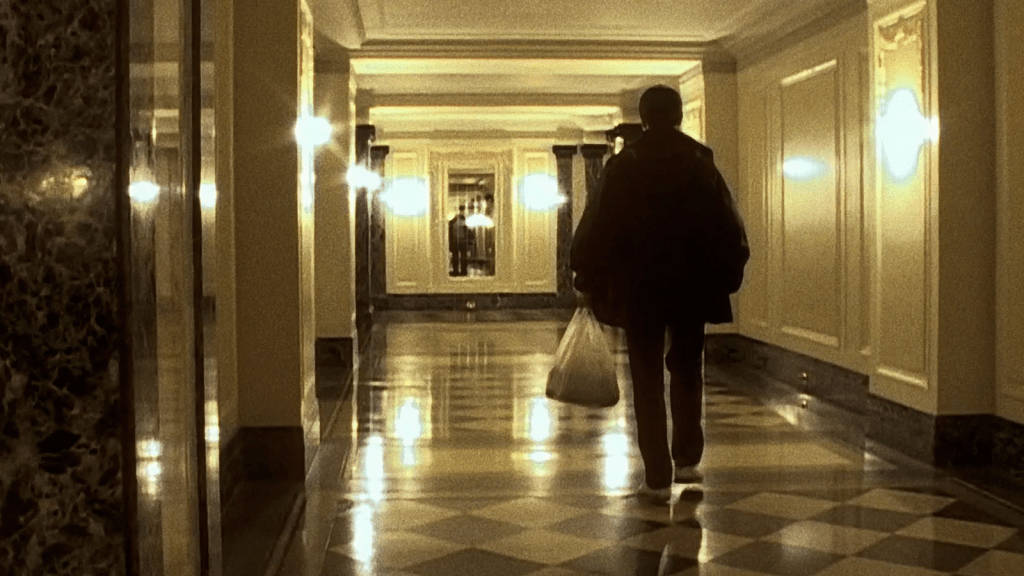
And indeed, this cramped kitchen environment, with the humming of its well-worn equipment and overhead lights and what I can only assume is an intoxicating mixture of culinary aromas, ends up contrasting in an unexpected way with the nondescript apartment hallways that Ming traipses down and the dull, heavy doors that denote a person’s living space. These plain spaces are not designed to be seen or entered by the public but they are where Ming must go to make his money, treading uncomfortably close to the private place where a stranger lays their head to sleep at night. Who is going to answer the door? Will they be wearing clothes? Are they going to be the worst person I meet today or unremarkable? The one time that Ming ends up inside one of these apartments due to confusion with the delivery feels like an unintended invasion. I have felt this, too, being asked to enter someone’s home to bring an order directly to their kitchen, a small voice in my head wondering, “They’re definitely not going to kill me, right?” Such is the life of dispassionate food delivery.
Take Out wraps up in just 88 minutes, but by the time the staff closes shop and finally head home it feels like an entire work shift has passed. It’s hard to believe that they will return to the kitchen the next morning to do it all again.
17. F1 Directed by Joseph Kosinski 2025
“Hope is not a strategy. Create your own breaks.”
The world’s most prestigious and problematic motorsport got its own movie starring Brad Pitt, directed by the guy what made Top Gun Maverick, and released by megacorp Apple, a degree of moneymaking star power well-suited to such a rich person’s playground as Formula 1. There’s always an inescapable degree of outside-looking-in with this sport, given that just about everyone involved has an incalculable degree of wealth, which might explain why the movie’s plot centers on a scrappy upstart team trying to build itself up into a serious competitor. You’re scrappy too! They’re just like you!
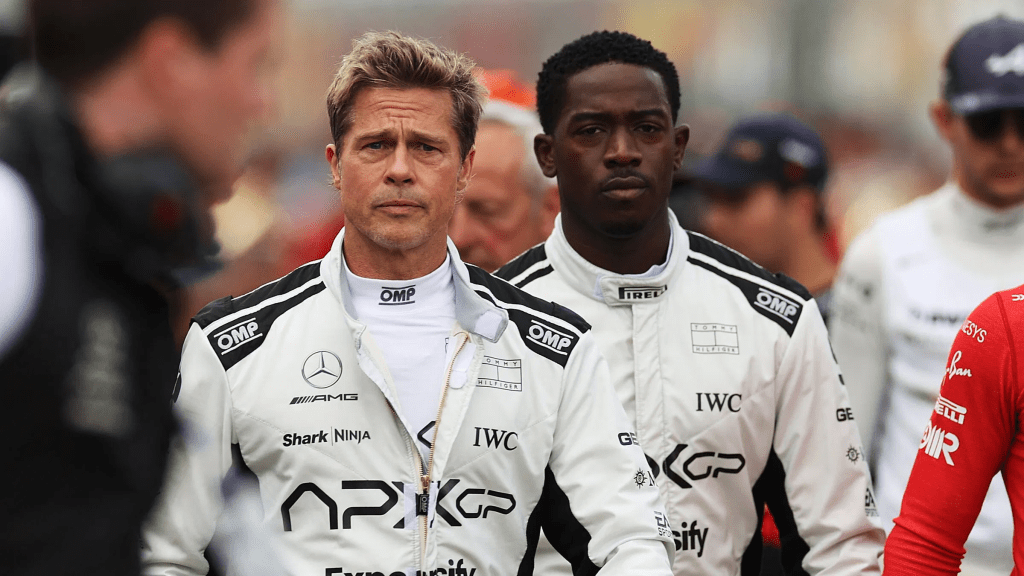
It’s not exactly the most groundbreaking sports drama ever told, but damnit if it isn’t just an exhilarating blockbuster all the same. The lengths the filmmakers went to capturing fast cars zooming around a track, to using convincing CGI to depict Pitt and and Damson Idris racing alongside real world drivers, to filming during an actual Grand Prix weekend (including having Pitt and Idris stand alongside the field of drivers during the opening ceremony and even having cars on the grid during the formation lap)… it’s all just amazing to watch, especially on the biggest possible screen. And Kerry Condon and Javier Bardem provide a good bit of supporting flavor to the proceedings.
The numerous cameos from real world Formula 1 personnel are fun but let’s be real, at some point this starts to feel like a bit of very expensive marketing for a sport that frequently cozies up to questionable heads of state and businessmen and plasters Saudi Aramco across every single track. It’s all the more curious when the film eventually paints the schemes of the wealthy as the true villain in the end, which would feel like a welcome bit of self-awareness if it weren’t for the CEO of Formula 1 having his own cute little cameo in the finale. But I’d be remiss if I said F1 (the movie) wasn’t viscerally thrilling.
16. Spartacus Directed by Stanley Kubrick 1960
“When a free man dies, he loses the pleasure of life. A slave loses his pain. Death is the only freedom a slave knows. That’s why he’s not afraid of it. That’s why we’ll win.”
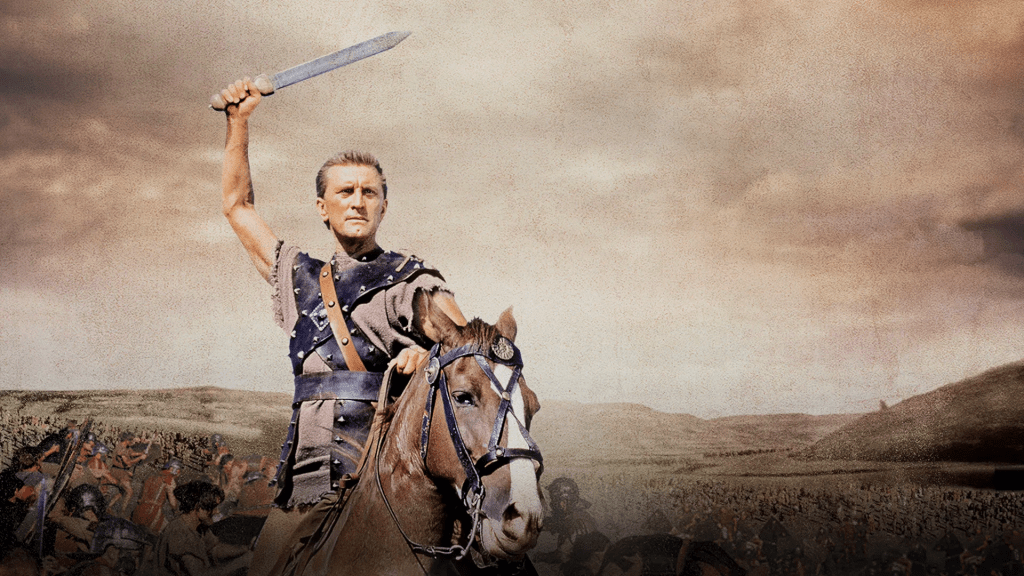
Oh, I really liked this. A 3+ hour long historical epic that never felt like it wasted time. As Kubrick came in as a backup director it doesn’t have quite as many of his definitive touches, and it’s a bit dismaying that he was seemingly unhappy with the result and wanted to distance himself from it because it may very well be my favorite of his early work.
Spartacus is like a worn and faded paperback novel you’d find inside a musty, dusty bookstore. You can almost pick up the scent of shelves lined with oft-turned pages in its warmth and adventurous spirit. The story of Spartacus, of a man who breaks free from gladiatorial slavery and leads an enormous rebellion against the forces of Rome in an attempt to get back home, is the kind of story you might imagine reading in a younger fairy tale version of yourself where you have a favorite tree that you like to sit underneath with a book, a pleasant breeze on the air as you get lost in the exploits spilling out across the pages. Everything is perfect here.
It’s also goofy as hell at times, whether from a sudden line of dialogue ADR’d in from a different planet (and actor) or a battle scene extra blandly swinging a bladed weapon in the most noncommittal manner. But it feels more in the vein of a production stretched to the limits for the time, and less an issue of filmmaking competence.
And there is a lot of skill that went into Spartacus. The costuming is outstanding. Seriously, all of the hundreds of people who appear in this film in some capacity look terrific, be they a slave, a member of the Roman senate, or an armored warrior. The same can be said of the believable location work, which stretches from rolling hilltops—complete with beautiful engrossing wide shots—to Roman government interiors and a gladiator school. Essential for a film of this scale, the sense of journey is excellent.
Kirk Douglas, who was a centerpiece of the movie’s inception, puts on a rather muted performance at first as the slave-turned-rebellion leader Spartacus, but he breaks out of the shell nicely in the back half of the story when he’s fully in command of an army. (I would find out later that Kubrick cut a lot of Douglas’ dialogue in the early parts of the film, which might explain this.)
Other actors turn in great performances, including Laurence Olivier as the ambitiously cunning Crassus and Charles Laughton—director of The Night of the Hunter (1955), which rules—as Gracchus, who has an enjoyable arc through the world of internal Roman politicking. One of the real standouts is Peter Ustinov as the gladiator school headmaster Batiatus, who seemed to have a lot of fun portraying the quick-thinking suck-up.
Spartacus does a fine job keeping track of its various characters, moving between the life of the slave rebellion and the discussions of Roman leaders with a great deal of confidence and consistency. This flow is helped tremendously by Alex North’s compelling and comprehensive score, a constant companion that employs a great variety of instruments and themes in nearly every scene.
It’s just a grand time. I can’t wait to open this book again.
15. A Woman Under the Influence Directed by John Cassavetes 1974
“Dad… will you stand up for me?”
One of the joys of moviegoing is discovering a film from decades ago that feels timeless and expands your understanding of where contemporary directors got their inspiration. In John Cassavetes’ A Woman Under the Influence there’s a pretty clear through-line to the sort of modern independent filmmaking that doesn’t hold your hand through its story, instead engrossing you in compelling character work and eschewing traditional narrative structure.
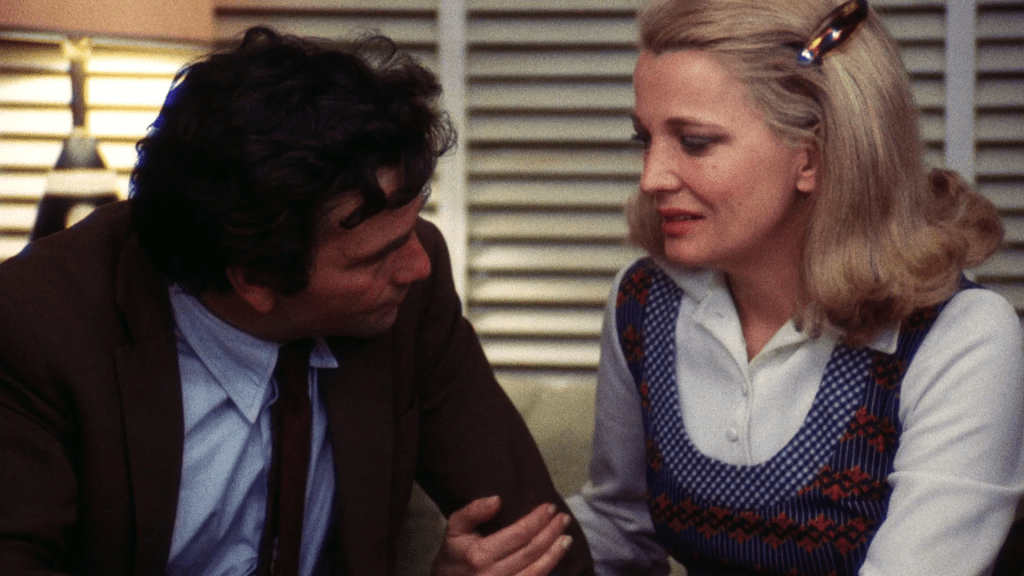
A Woman Under the Influence is about a woman named Mabel—an exceptional performance from Gena Rowlands—struggling mightily to find happiness and companionship with her husband (Peter Falk, also excellent) and children. As her mental health and behavior worsen, her family becomes increasingly embarrassed and concerned for her well-being and their own.
What is Mable under the influence of, with her confused facial expressions, awkward social interactions, and frantic aloofness? An unhappy life at home with an obviously mentally troubled husband? The gender roles that say she must stay there to tend to the children and prepare large meals for hubby’s work friends when he brings them over unannounced? Perhaps her struggles started sooner but were aggravated by a society that was certainly unkind in its treatment of mental health—just look at the way she’s berated by her wicked mother-in-law and her mention of undergoing shock therapy at the mental hospital she’s sent to for six months. At no point does anyone in the film really connect with her, but she appears to find peace when in the comforting embrace of her children. Even the act of putting the kids to bed is a profoundly warm moment for Mabel. But every interaction she has with adults is painfully sad to witness, as if she were speaking a completely unknown language.
What brings it all together is the grounded manner in which A Woman Under the Influence is scripted and filmed, an almost home video-style approach where the camera always feels like it’s mixed in with the characters and everyone talks over one another in a believable way. It’s immersive and so difficult to look away from, as it might be were one to actually be in the room as these events transpired.
14. High and Low Directed by Akira Kurosawa 1963
“I don’t care if I go to hell. My life has been hell since the day I was born. But if I had to go to heaven then I’d really start to tremble.”
I had an inkling that fabled Japanese director Akira Kurosawa was an all-timer after watching Seven Samurai, a film that I was marginally cooler on than most but that I’ve only grown to appreciate more over time. This second film that I’ve now watched, his 1963 police procedural High and Low, is an easier entry point to his filmography given its shorter run length and more immediate, focused plot.
It’s an enthralling tale steeped in themes related to social and economic disparity, with a steady momentum that goes to some truly unexpected destinations, and the whole thing is beautifully staged like a theatrical play. Watch as characters pace around the screen but never actually leave it—there’s so much weight to people hanging around in the corners of the frame, eyes down or off in some other direction contemplating, or perhaps listening, as others closer to the center engage in discussion. It’s an immersive and compelling style of filmmaking that really stands out.
13. 28 Years Later Directed by Danny Boyle 2025
“Remember we must die.”
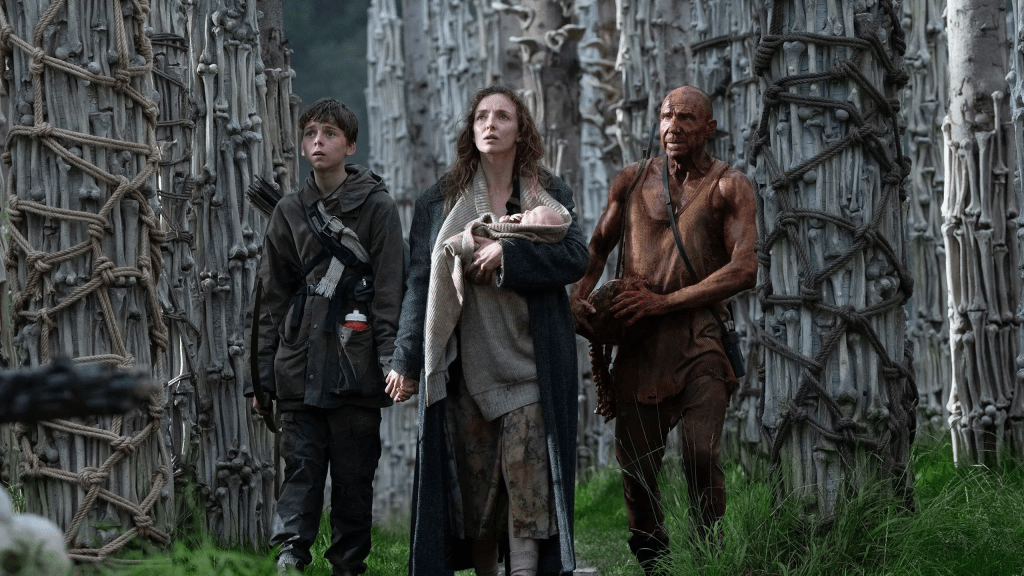
I wasn’t totally blown away by Danny Boyle’s influential 28 Days Later when I finally watched it earlier this year, probably because I had already been exposed to the two decades of zombie fiction it inspired, but something about its grimy aesthetics stuck with me enough that I jumped at the opportunity to see this long-awaited follow-up.
I was very surprised and impressed by the directions this takes, from the frenetic way it’s shot (that huge iPhone rig is crazy) to the editing that sees early portions of the film interspersed with scenes from the 1944 film Henry V and British war footage, a choice that digs into the film’s themes about selective mythologizing.
The real highlight, though, is the climactic scene where young Alfie, having escorted his dying mother to a doctor in an attempt to save her life, must instead reckon with her impending passing in a remarkably insightful sequence that says more about life and death than any zombie fiction I’ve encountered. Boyle done good with this one.
12. Queens of the Stone Age: Alive in the Catacombs Directed by Thomas Rames 2025
“Look at you now.”
If we think of American rock band Queens of the Stone Age as having two distinct halves to their career thus far–the first, their run of records from their self-titled debut in 1998 to 2007’s “Era Vulgaris” that saw them in a youthful chase for inspiration and new sounds every couple of years, and the second, the sort of unofficial trilogy of records from “Like Clockwork” to “In Times New Roman” that were defined more by lengthier gaps between releases and frontman Josh Homme’s personal struggles fueling a darker, angstier sound–then this live EP/film starts to feel a lot like a post-credits scene. It also just might be a creative high point for the band nearly 30 years into their career.
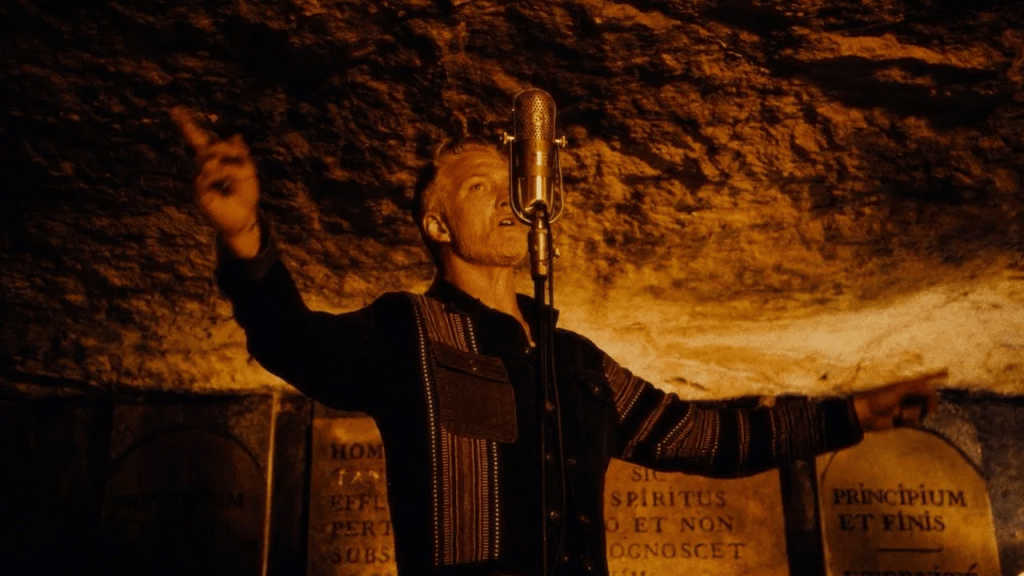
Delving deep into the catacombs of Paris where the remains of six million people are housed, a trio of string players in tow, the band seeks to mine their catalog for some deep cut material that might appropriately match the energy of the venue. The set list, stretching back to their 2005 release “Lullabies to Paralyze,” contain some real surprises and each one is meticulously and beautifully arranged.
Crucially, the context of Homme’s health issues at this time lend a greater air of importance and urgency to the EP/film. He was hospitalized for an undisclosed health issue immediately after recording Alive in the Catacombs and was in immense pain during the taping, something you can hear in his voice at times and see on his face throughout. It’s also evident after seeing the band perform the songs in Boston this year–Homme looked and sounded sharp as hell, hitting the high notes of “I Never Came” that he probably couldn’t while underground in Paris. He may have been in a weakened state, but the pain he brought to a concert for the dead certainly made for a more fitting endeavor, something that he himself has agreed with in interviews after the fact.
It’s also just an immaculately produced film with lots of warm lighting and a tight 4:3 aspect ratio that lends itself well to the confines of the space. The sound mixing is outstanding, not only emphasizing the prominence of each instrument but also capturing the dripping condensation and hard footsteps on the floor of the catacombs. It’s a wholly immersive experience from start to finish and the band’s most assured and creatively interesting project to date, to say nothing of the outstanding Catacombs Tour that it has inspired–seeing them perform even more deep cups with a similar treatment (and not just with strings but horns as well) in an old theater feels like an unknown dream come true.
11. Sunshine Directed by Danny Boyle 2007
“The point about darkness is, you float in it. You and the darkness are distinct from each other because darkness is an absence of something, it’s a vacuum. But total light envelops you. It becomes you. It’s very strange… I recommend it.”
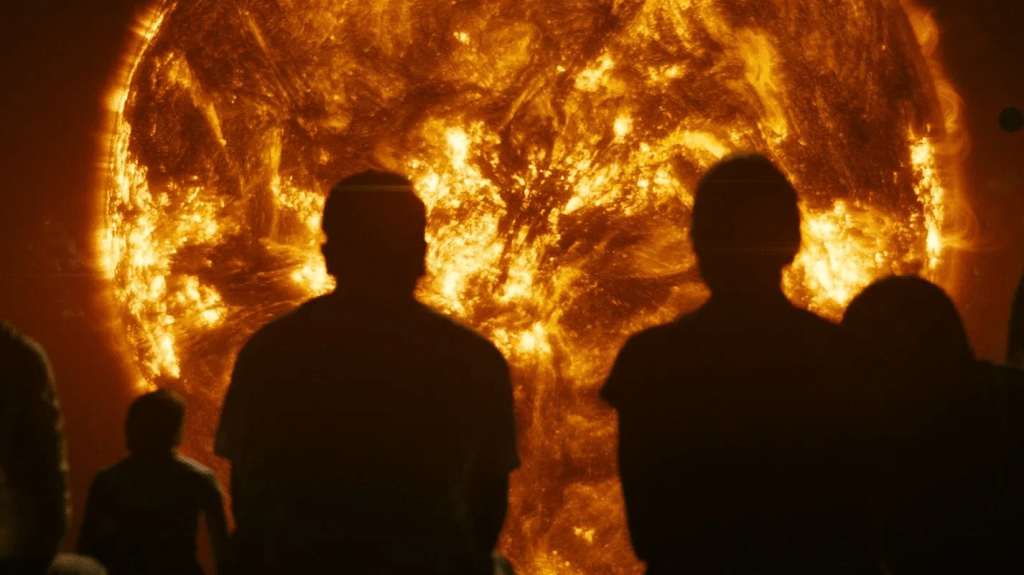
There’s an existential power to this philosophical science fiction film from Danny Boyle and Alex Garland about a crew of astronauts who embark on a last-ditch effort to reignite the dying Sun with an explosive payload and save an otherwise doomed Earth. When’s the last time you thought about the Sun? Really thought about it? That unconscionably immense sphere of energy in the sky that grants this planet every bit of its life and that will ultimately consume it at some time in the far distant future. What might it be like to visit such a thing, to bring oneself into the terrifying encompassing proximity of life’s origin point? Would you too be driven mad by its overwhelming power? Would you too bask in its glow for so long that it begins to char your skin, burning you down one layer at a time? Sunshine is an apocalypse story, but it’s also a story of a group of men and women having to reckon with their own existences, so minuscule in the eyes of a star and in the context of the greater universe.
The film jostles between imposing shots of the ship with its enormous heat shield to the interior rooms and corridors, where the camera is often peeking through and around parts of the ship or offering an extreme close-up of someone’s face. Light is treated as a violent force, cutting sharply across the frame on several occasions and enveloping the screen in obfuscation in others. As the payload nears its destination, Boyle captures the chaotic unknown of being surrounded by such awesome mass and density with chaotic visual effects that wash over you in a wave of reality distortion. On first viewing the third act of the film seriously threw me for a loop; on my second viewing I was fully bought in to the fabric of time and space ripping itself apart.
It’s an incredibly tense film, with terrific music and suspenseful moments where our astronauts thread the needle between survival and immediate death. The dramatic set piece moments come at a brisk pace, making large parts of the film feel breathlessly nerve-wracking, but without overdoing it. Quieter moments, like the crew watching Mercury transit across the Sun in awe, are just as impactful.
It’s a do-or-die mission to the beginning and end of all things. The cosmically microscopic scientific pursuits we hope will save us, bracing against the raw spiritual power of simply giving oneself over to the abyss. On a purely existential level this is maybe the most frightening movie I’ve ever seen. My God is the Sun.
10. Perfect Days Directed by Wim Wenders 2023
“Next time is next time. Now is now.”
It’s good to know that in the thirty-six years that elapsed between Perfect Days and Wings of Desire the German filmmaker didn’t lose hold of the drive to film the quiet, contemplative side of human existence. While this third film in my Wim Wenders journey is unmistakably a product of the celebrated Paris, Texas director and the sensibilities that have guided him through these movies, the circumstances behind Perfect Days are quite different, Wenders having been invited to Japan to produce a short film promoting the construction of high-quality public restrooms in Shibuya.
Evidently Wenders saw something more in these facilities—together dubbed The Tokyo Toilet—to instead put together a feature-length film, and it’s not difficult to see why. The restrooms, designed by several architects of renown, are indeed quite beautiful and carry unique characteristics, such as the transparent facilities whose walls become opaque upon locking the doors. There was clear attention paid to not just the function but the aesthetics of each and how they might relate to their surroundings—the mushroom restrooms nestled among some trees are another highlight. The inspiring designs get the wheels turning: who maintains the quality of these facilities, and what might their day be like tending to these works of infrastructural art?
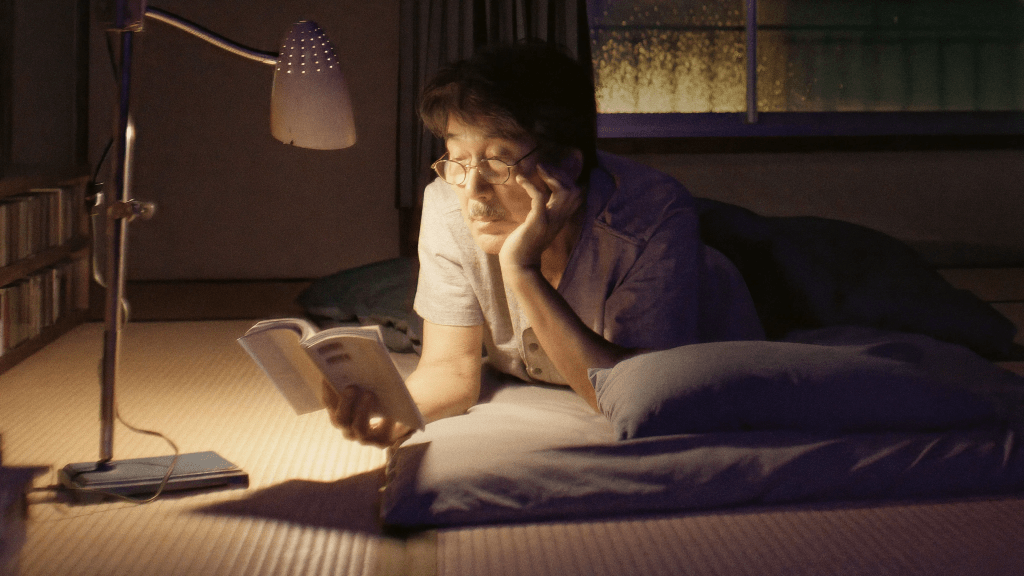
Hirayama is the guy, a man with some years behind him and a love for cassette tapes. Every day of his work week he dons a recognizable blue jumpsuit and navigates the city streets and highways of Tokyo in a blue van. At each facility he unloads his gear and chemicals and gets to work, picking up every bit of scrap and polishing every bit of surface. Every now and then someone enters to use the restroom, and Hirayama respectfully steps out—another chance to look up at the trees, a past time of his.
Notably, Hirayama glaces up at the leaves and tree branches above him every time he steps outside in the morning to go to work, and in his off-hours takes photographs of nature with a small film camera. Throughout the film Hirayama, gently portrayed by Koji Yakusho, wears a quiet pride and contentment on his face, happy to just be getting by and seemingly unbothered by much of anything. Something deeper within threatens to come out on a couple of occasions—one, when his outwardly wealthy sibling questions his career choice, and again after the fact when his face undergoes a series of emotions that never quite break out. Wenders never reveals Hirayama’s backstory in the film, opting instead for a very in-the-moment slice-of-life approach. The feeling that something is lingering there beneath the surface is thus left unexplained.
But it’s a real delight watching Hirayama do his thing. Franz Lustig’s cinematography, the sunny concrete beauty of urban Japan, and the closeness of the 4:3 aspect ratio make for a visually appealing film, especially when Hirayama is driving along a highway, camera pointed out the side window so we can see the van reflected back at us in the windows of the skyscrapers passing by. And bookending each day are brief dream sequences that offer fuzzy glimpses at the people and places occupying Hirayama’s sleeping mind, a distinct touch that offers a good bit of texture to his life.
Taking pleasure in the simple joys of life is the obvious message here, but the film also makes one long for a world where these sorts of projects—be they funded by entrepreneurs or non-profits or, get this, the government—were more commonplace. Why can’t we have better infrastructure and facilities that not only ease the burdens of life and preserve our dignity but that are also designed with an eye for the environment and human expression? In both The Tokyo Toilet and Hirayama I see the same thing: the potential for simple everyday moments to be great if we just make it so. Leave it to Wim Wenders to pull off another characteristically human story in an advertisement.
9. The Passion of Joan of Arc Directed by Carl Theodor Dreyer 1928
“You claim that I am sent by the Devil. It’s not true. To make me suffer, the Devil has sent you… and you… and you… and you.”
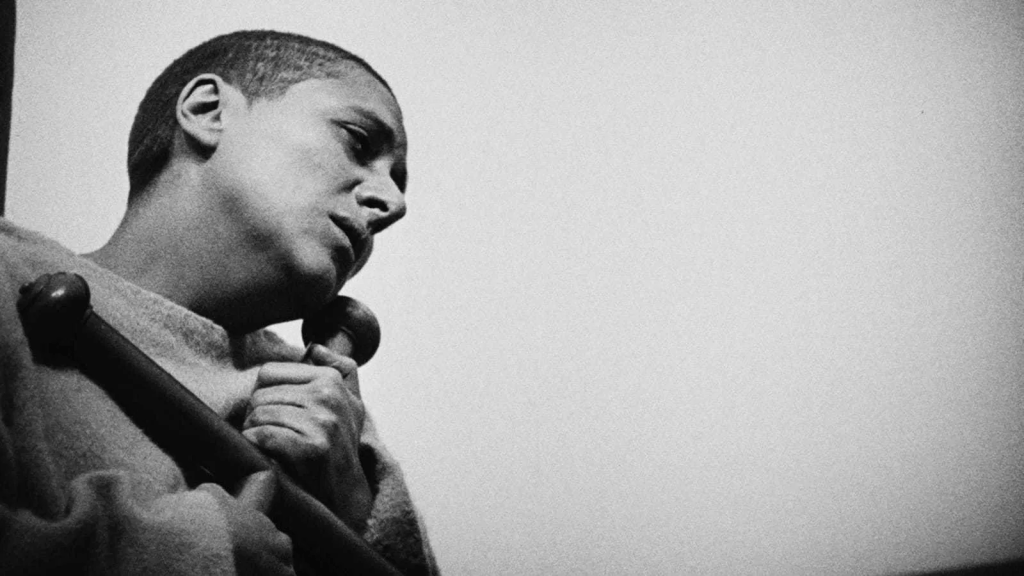
The Passion of Joan of Arcis a Citizen Kane-level revelation, the sort of archaeological find that reshapes how you think about the history of cinema. Where once Citizen Kane was the earliest and most foundational work I had seen, demonstrating a stunning level of modernity in its cinematography and narrative form, here is a film from thirteen years prior that is just as striking for its skillful use of the medium. Director Carl Theodore Dreyer and cinematographer Rudolph Maté craft an unforgettable portrait of the legendary French martyr using dramatic close-ups of the subject and the furious, conniving judges who are determined to see her life end.
The facial acting is superb, whether its Maria Falconetti as the titular character bemoaning her fate or a judge furiously scolding her for perceived blasphemy. It’s incredibly impressive how much emotion is conveyed here despite the score being the only sounds to come out of this film. Against the stark concrete set these characters jump out, and the 1.33:1 aspect ratio boxes the viewer in, making Joan’s trial and execution feel inescapably real. This is a powerfully moving production.
8. Batman Returns Directed by Tim Burton 1992
“Seems like every woman you try to save ends up dead… or deeply resentful. Maybe you should retire.”
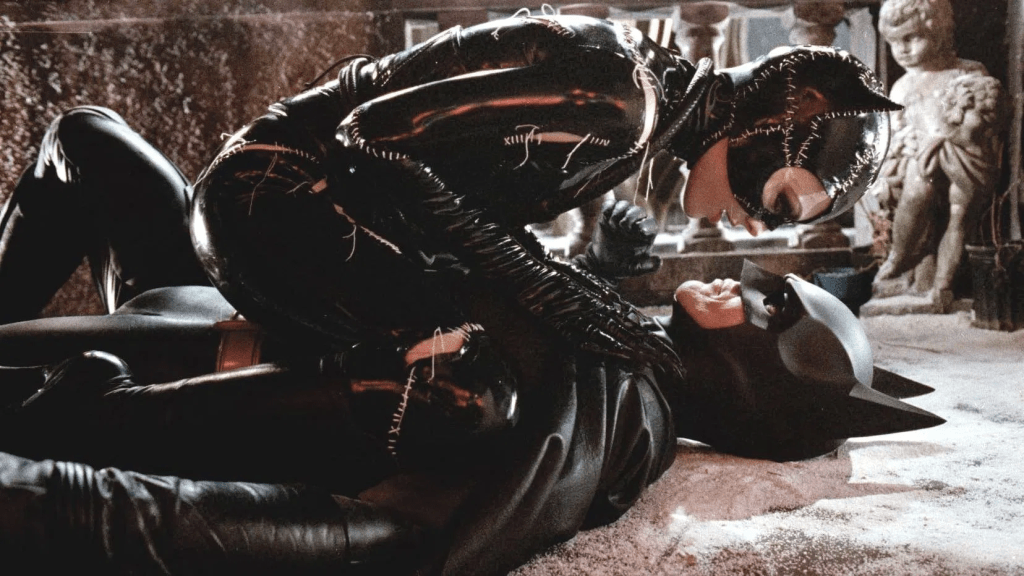
I’m not sure if missed something with Tim Burton’s Batman (1989) or if it’s follow-up is just that much better, but I went into Batman Returns with a fair bit of skepticism and was struck by how much more I enjoyed it than its predecessor. Pre-MCU superhero films are fascinating to visit; it’s easy nowadays to forget that filmmakers had to bring these comic book heroes to life without the precision of a focus group-tested formula, sardonic witty dialogue, and expensive digital effects. But while I appreciated the 1989 Batman for being weirder than, say, the Christopher Nolan trilogy, it also felt fairly sedate and underwhelming to me.
Batman Returns is considerably more striking in its cold, angular, noir-ish rendition of Gotham City and the miserable loner trio of Batman, Catwoman, and Penguin who brush up against each other with unresolved angst. Michelle Pfeiffer is stunning as Catwoman, expertly capturing the elegantly deranged and scratchy feline persona of a woman restored to life by a clowder of stray cats after being defenestrated by an eagerly corrupt industrialist (a handsome Christopher Walken). Danny DeVito’s Penguin is an unnervingly tragic and grotesque villain, abandoned as an infant and left to grow up in the sewers, desperate in his adult life to be seen by and accepted into the superficial society that cast him away. And Batman himself appears aimless and insubstantial, idling by his fireside television in the hopes that Catwoman or Penguin will act up, giving him cause to spring into action. If I thought Michael Keaton as Batman was an odd choice in the preceding film, here it feels better-suited for this reclusive portrayal. In Batman Returns there are no more heroes in Gotham, only freaks trying to out-freak each other.
7. Uncut Gems Directed by Benny Safdie, Josh Safdie 2019
“That’s a million-dollar opal you’re holding. Straight from the Ethiopian Jewish tribe. I mean this is old-school, Middle-earth shit.”
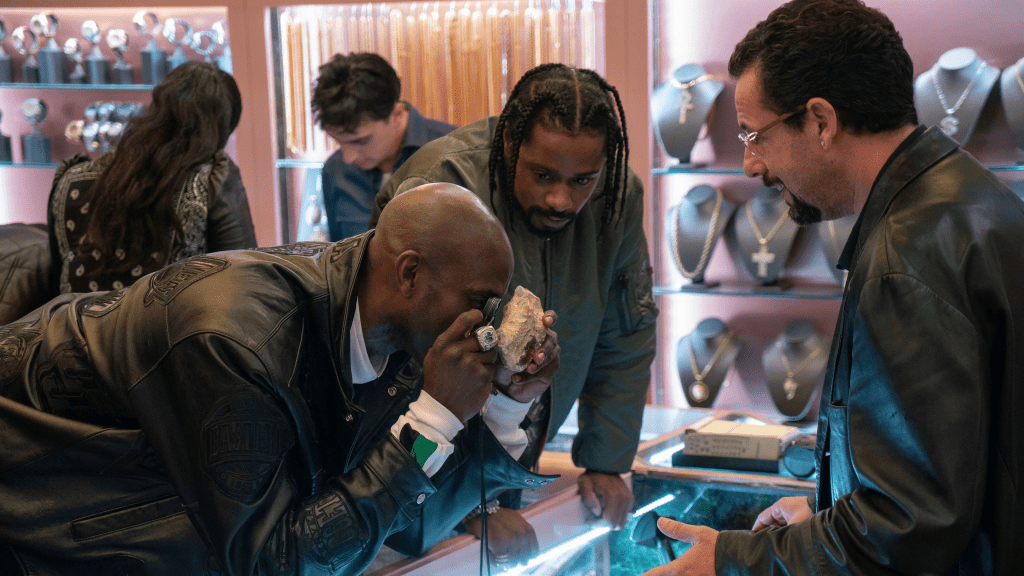
Frantic, a two-hour bout with anxiety that’ll leave you breathless and with a renewed fury towards the Supreme Court for paving the way for widespread destructive sports betting. Filled to the brim with really well-choreographed shouty scenes that remind me of why I liked Anora so much last year, and it’s all shot so well and with a keen eye for setting—the brightly lit clustered jewelry shop where Howard (Adam Sandler in what must be his greatest career moment) tries desperately to keep all of his dealings aligned as the walls close in around him feels like a character in and of itself.
Part of what makes Uncut Gems so amazing is the amount of empathy it managed to generate in me for Howard’s plight, in spite of him being a sad sack of a father and husband and carrying an overall scummy disposition. I found myself rooting for him in the end in large part because Sandler plays the role with so much delicacy and fear. Howard comes across as boisterous and confident but you can tell he’s always one or two faults away from completely cracking apart, and when he does get his ass handed to him it’s almost heartbreaking. You can see the addiction to bad money habits ripping him apart, you can see how deep down he knows this, but he can’t keep himself away from the hustle anyway. By the end he seems less excited about the prospect of scoring big on a bet and more desperate for it to work out because he knows he’s running out of cards to play. All the while the tight close-up camerawork ensures that while Howard is panicking, we practically are too.
6. Sorcerer Directed by William Friedkin 1977
“We’re carrying three cases each. One is enough to blow out your fire, six cases will blow out the whole field. That means you don’t think all the trucks will make it, one of us is a backup.”
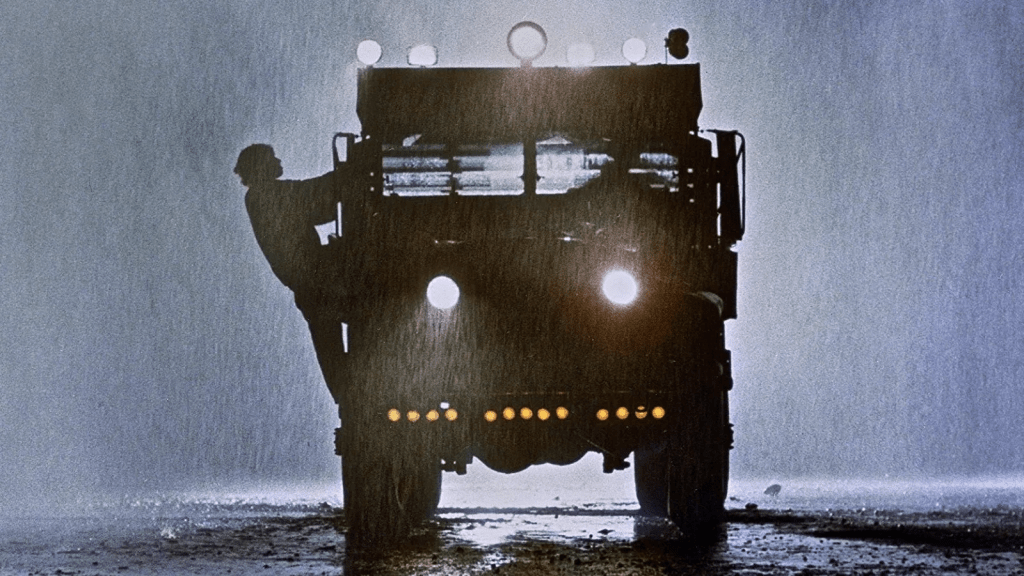
Four disparate men at the end of their ropes in Central America, tasked with trucking volatile dynamite across jungle terrain. An impossible movie drowning in sweat and dirt and oily, existential despair, two hours at the hands of bad luck and the wretched situations we inflict on ourselves and others and the world around us, brought together through wickedly impressive practical effects and stunt work and documentary-style scenes that erase the boundaries between fiction and reality.
Sorcerer is the ultimate “they don’t make ‘em like they used to” film, an absolutely harrowing movie in premise and execution. The journey these men take in these rickety trucks across nearly impassable terrain is so believably dangerous that I was practically begging for a reprieve by the end. The bridge sequence, the montage of assembling the trucks DIY-style, the crazed, desperate ending, it’s all uncomfortably tangible and unrelenting, up there with The Texas Chain Saw Massacre as one of the grimiest, filthiest movies I watched this year. That this was William Friedkin’s next project after The Exorcist is some serious versatility.
5. The Florida Project Directed by Sean Baker 2017
“Excuse me. Could you give us some change, please? The doctor said we have asthma and we have to eat ice cream right away.”
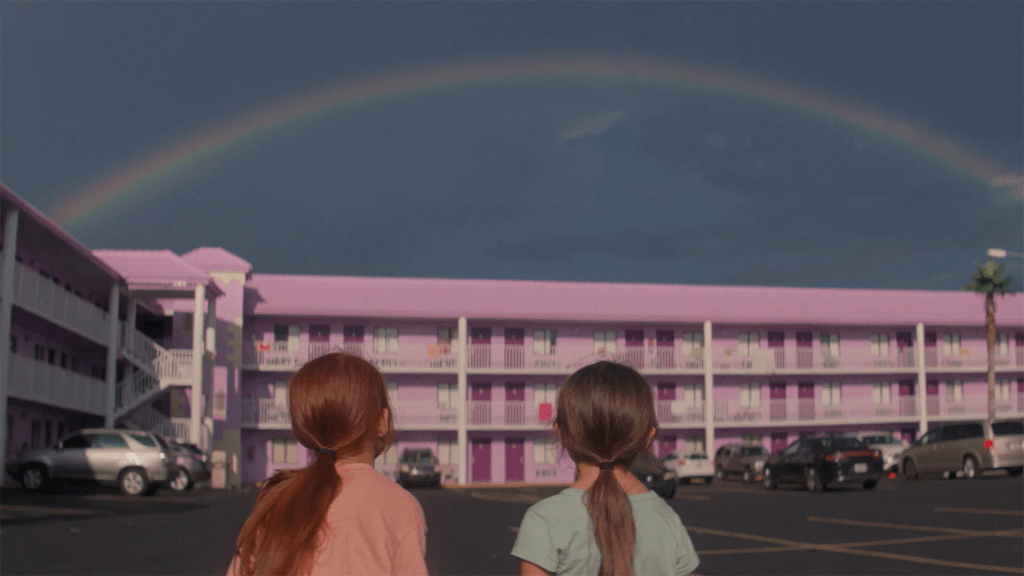
It feels right to have found my way to The Florida Project so soon after visiting the state on a road trip that had me sweltering under cloudless skies and puttering down ultrawide roadways that zoom past the palm trees and motels and chain restaurants that make up this film’s very real setting.
Everything is too big in Florida. The sky is too big. The roads are too big. The cars and trucks are too big. The parking lots and retail sprawl are too big. The trees and wildlife are too big. Everything feels outsized. As a native of Maine’s small towns, I feel dwarfed by the scale of life and all things in Florida.
The Florida Project imagines these enormous spaces as playgrounds for the children of budget motels nestled along the highways that ferry tourists and their MagicBands to Disney World. Where director Sean Baker had previously focused his storytelling on the adults who live on the fringes of society, here the lens is on the joyous carefree ignorance of their children, who see everything as an adventure—whether it’s exploring an abandoned condo or begging for change at an ice cream stand.
The portrait painted by The Florida Project—penned by Baker and frequent collaborator Chris Bergoch and filmed beautifully by Alexis Zabe—creates a perfect juxtaposition of adventurous youth and maximally-stressed adulthood. The setting goes a long way: it’s equal parts charming and bleak watching these kids gallop across parking lots and expansive roadways, the ceaseless sounds of motors constantly in the background. You can practically smell the exhaust and feel the heat radiating off the pavement, an hour-fifty reminder that America is not built for pedestrians, nor children, nor the impoverished.
Willem Dafoe makes a surprise appearance as the down-to-earth motel manager, an uncommon level of star power for a director who typically casts unknowns in his films. The rest of the cast, adults and child actors alike, join the lineage of amazing performances that make these films so compelling and real. The central driving force is the collision between the kids galavanting through their world and the adults who are constantly teetering on the breaking point, unsure of whether they’ll make their next rent payment or be able to secure food. The Florida Project grounds itself well in its setting, allowing character arcs to play out as we become increasingly accustomed to the candy-pink motel. It’s some of the most effective storytelling in his filmography.
4. The Texas Chain Saw Massacre Directed by Tobe Hooper 1974
“Come on, Franklin! It’s gonna be a fun trip! If I have any more fun today, I don’t think I’m gonna be able to take it!”
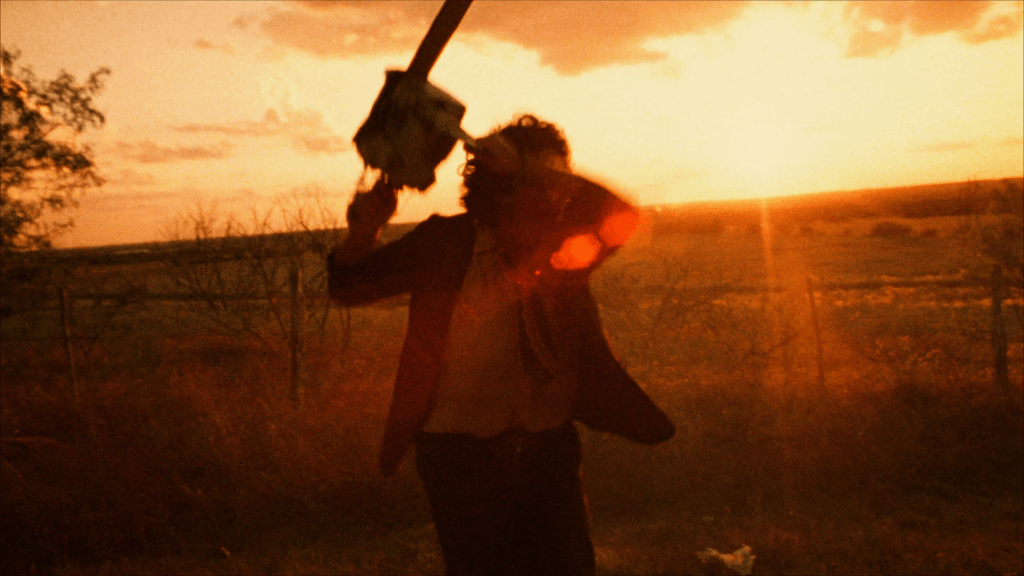
An absolute shocker of a film, an unrelenting body slam of degradation and unholy brutality. One of the most perfect set-ups and endings of a horror film I can imagine, a journey from privileged American youth unwilling to confront the realities of industrial animal slaughter, and in turn the basic underlying cruelties that facilitate our everyday existence, to a blood-soaked psychopath maniacally swinging a chainsaw in the glow of a rising sun over the Texas landscape, having reduced nearly all of them to shreds of flesh and bone. If The Texas Chain Saw Massacre was born from the minds of creators frustrated by the economic downturns, federal government scandals and Vietnam War atrocities of the time, what a thing it is to be watching this in 2025 as the worst federal administration in our nation’s history disembowels government services and kidnaps people off the street, tech CEOs unleash worthless AI tools so they can annihilate creative industries and further the cataclysmic misinformation crisis and enshitification of the Internet, and a genocide casually unfolds on the other side of the world.
A pissed-off movie for a time when everything sucks and the line separating “civilized” humanity from its barest barbarous instincts is only as thick as your denial will allow. That time is now, folks!
3. Chungking Express Directed by Wong Kar-Wai 1994
“We’re all unlucky in love sometimes. When I am, I go jogging. The body loses water when you jog, so you have none left for tears.”
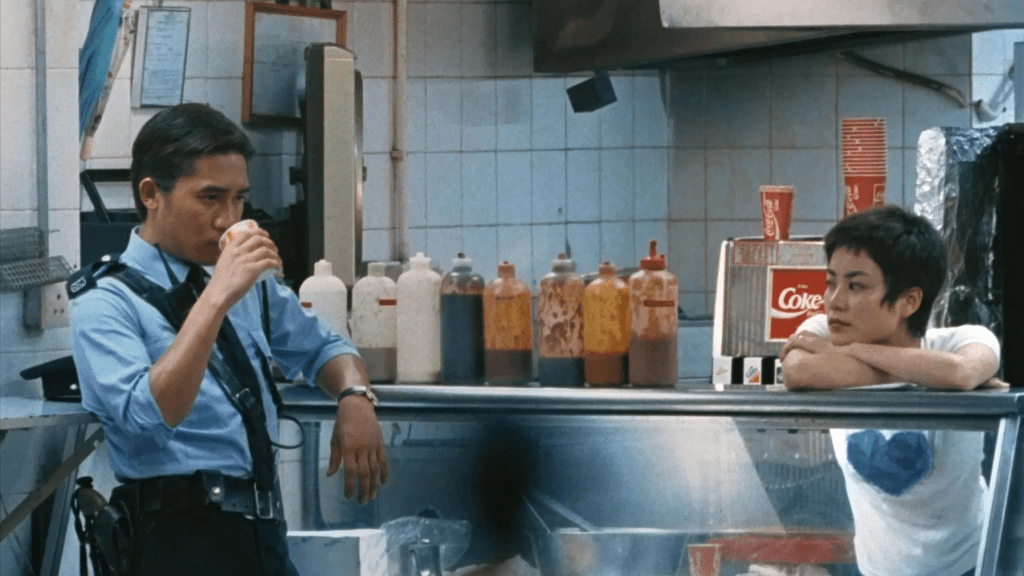
Few films wormed their way into my head this year quite like Chungking Express, an artful pairing of romance stories centered around a couple of jaded Hong Kong police officers who find love in unexpected places. There’s a lot of unconventional stuff in Chungking Express—the dual narrative, the low frame rate sequences, the repetitive use of certain songs, the occasionally silly loner narration—and they all lend themselves to a film that is emotionally affecting, albeit in a soft, almost unnoticeable way. It is a vibes movie through and through, one that I revisit not for the story but for the single-person-in-90s-Hong-Kong immersion. Its charms can be a bit opaque at times, but there’s also an intimacy to the fullscreen, close-up handheld camera work that makes the streets, alleyways and restaurants of Hong Kong really come to life.
The first story is great, with Takeshi Kaneshiro’s “Cop 223” falling for a cool mysterious woman in a blond wig and sunglasses (Brigitte Lin)—I could watch the two of them hanging out in that bar for an entire film. But the highlight for me is the second story, where Tony Leung Chiu-wai’s “Cop 663” captures the affection of the whimsical Faye (Faye Wong), who takes it upon herself to begin sneaking into his apartment to clean it while he’s away. What the two stories have in common is an understanding of life’s fleeting moments, captured in close quarters through creative angles, reflections, and camera movement, a dynamism brought together by our own proximity to everything and everyone, needing only the opening chords to “Dreams” to envelop someone in the moment.
2. Dr Strangelove or: How I Learned to Stop Worrying and Love the Bomb Directed by Stanley Kubrick 1964
“Mr. President, we are rapidly approaching a moment of truth both for ourselves as human beings and for the life of our nation. Now, truth is not always a pleasant thing. But it is necessary now to make a choice, to choose between two admittedly regrettable, but nevertheless distinguishable, postwar environments: one where you got twenty million people killed, and the other where you got a hundred and fifty million people killed.”
Dr. Strangelove is one of the funniest movies I’ve ever watched and one that is so in tune with the sense of humor my friends and I had through our World and European History classes in high school that watching this film feels like traveling back in time. Viewing history through a lens that sees 20th century global politics and conflict for the absurdity that it was you can’t help but see punchlines everywhere you look. How else to treat the unthinkable destruction, the humankind-eradicating inventions and the cartoon, boisterous, larger-than-life leaders and generals who orchestrated it all than with deadpan and a grim, resigned laugh? Dr. Strangelove correctly understands the fundamental relationship between humor and tragedy better than anything I’ve seen.
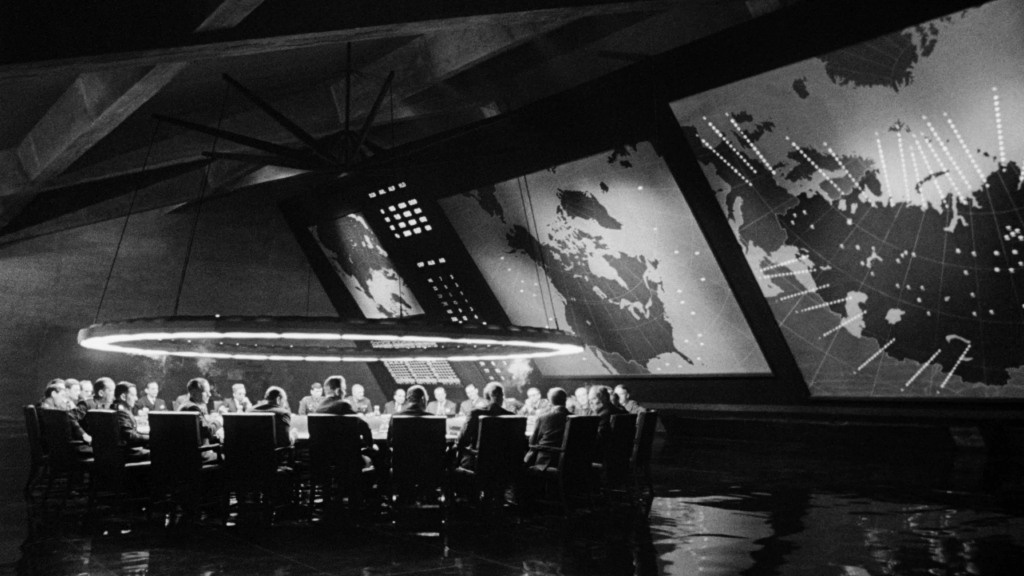
Peter Sellers and George C. Scott absolutely steal the film, with the former portraying three distinct and memorable characters and the latter absolutely devouring the scenery as a frantic chewy general with a penchant for limiting casualties to ten to twenty million, tops (depending on the breaks). Sterling Hayden, one of the best parts of the earlier Kubrick film The Killing, also appears as the paranoid Air Force base commander whose determination to protect his bodily fluids from the communists sets the film’s deadly events in motion. And who can forget the War Room, the enormous round table with stark overhead lighting and the coveted Big Board displaying a world map with locations of missiles in flight, which must be kept from Russian eyes at all costs?
Having watched the first half of Kubrick’s filmography this year—and having already seen most of the latter half of his career—Dr. Strangelove feels like a turning point where the director was now ready to fully embrace his voice as a filmmaker. After spending the preceding twelve years developing his techniques and flirting with brilliance (Paths of Glory, The Killing), now, in 1964, we have a director ready to embark on a legendary run that would see him redefine science fiction (2001: A Space Odyssey), war (again, with Full Metal Jacket), and horror (The Shining), among other things. I don’t know yet if Dr. Strangelove is my favorite Kubrick, but it may very well be. For now, anyway.
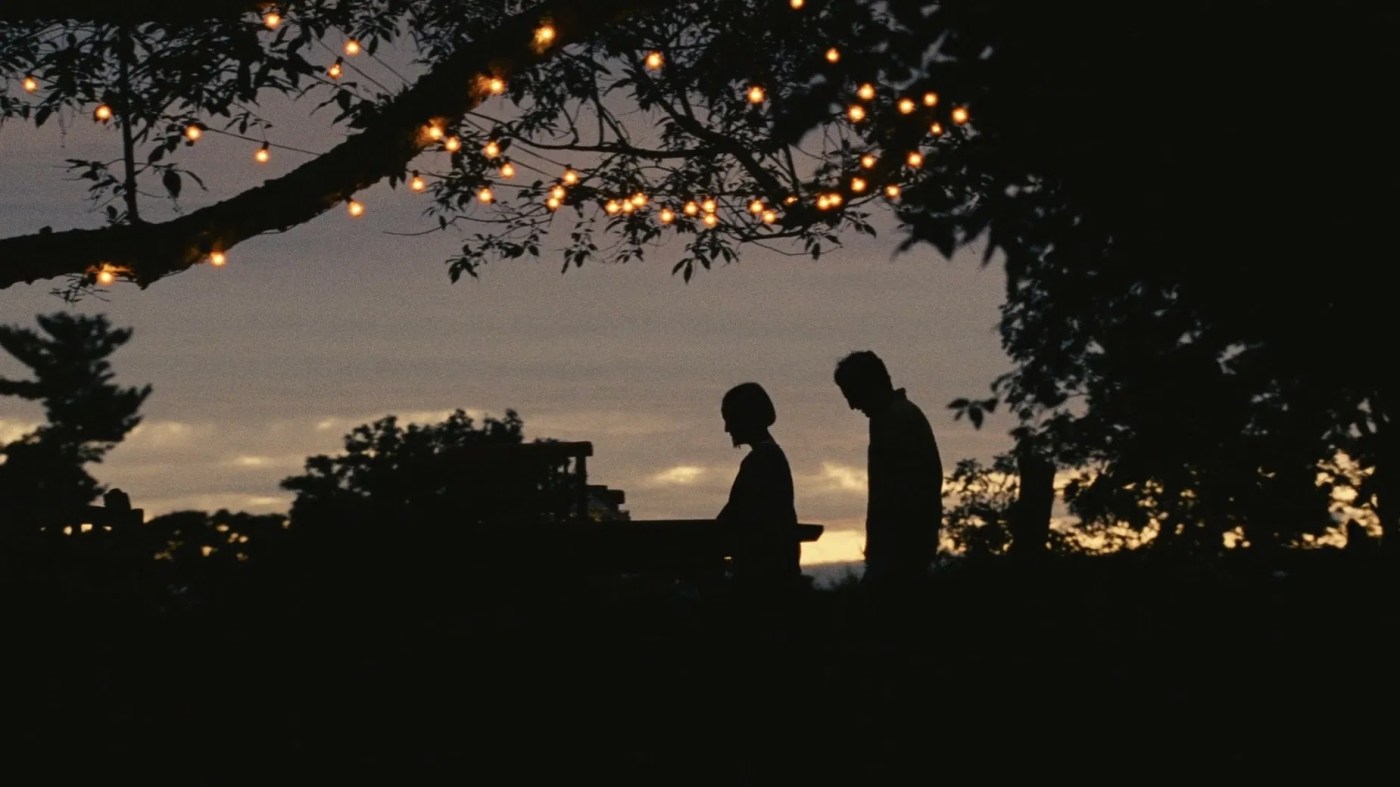
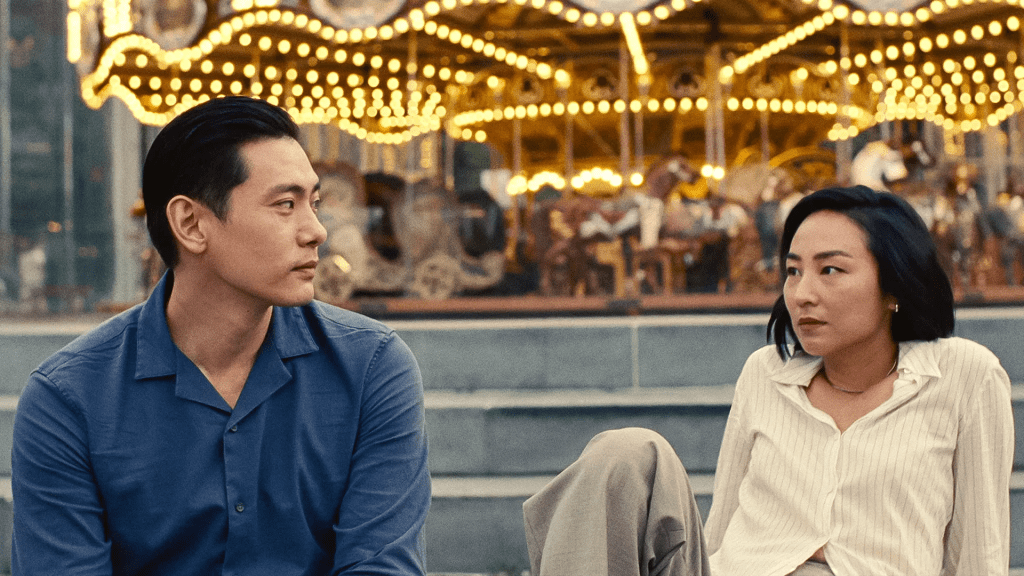
1. Past Lives Directed by Celine Song 2023
“It’s just that you make my life so much bigger. And I’m wondering if I do the same thing for you.”
Céline Sciamma’s achingly heartfelt Portrait of a Lady on Fire (2019) made the top three of my favorite first time watches last year and now a different Celine S. has done it again with Past Lives, a pure, breathtaking distillation of the lingering aches that come with a modern society that enables us to leave behind our deepest connections to reinvent our lives. On more than one occasion did Past Lives swerve away from where I thought it was heading, and each time I found a deeper truth than I would have had it simply stayed the course that I felt belonged to it.
Whether we believe in an actual past life for ourselves or not, the echoes of who we used to be in this life can be found not only in old faces but in the breeze that carries down a street as two souls lock eyes in silence, as if contemplating the enormity of all things. Past Lives’ assertion that it is well and good to ask questions about the nature of our own missed opportunities and destinies so long as we’re ready to accept the answers given is the bow that ties everything together, to say nothing of the performances from Greta Lee, Teo Yoo, and John Magaro who portray this moving story with grace and a palpable weight that makes every scene feel heavier than the world itself. Past Lives was an emotional blow more potent than anything else I watched this year.

 Nate Andrews
thanks for the reviews, I will be watching a lot of these over the winter months!
LikeLike