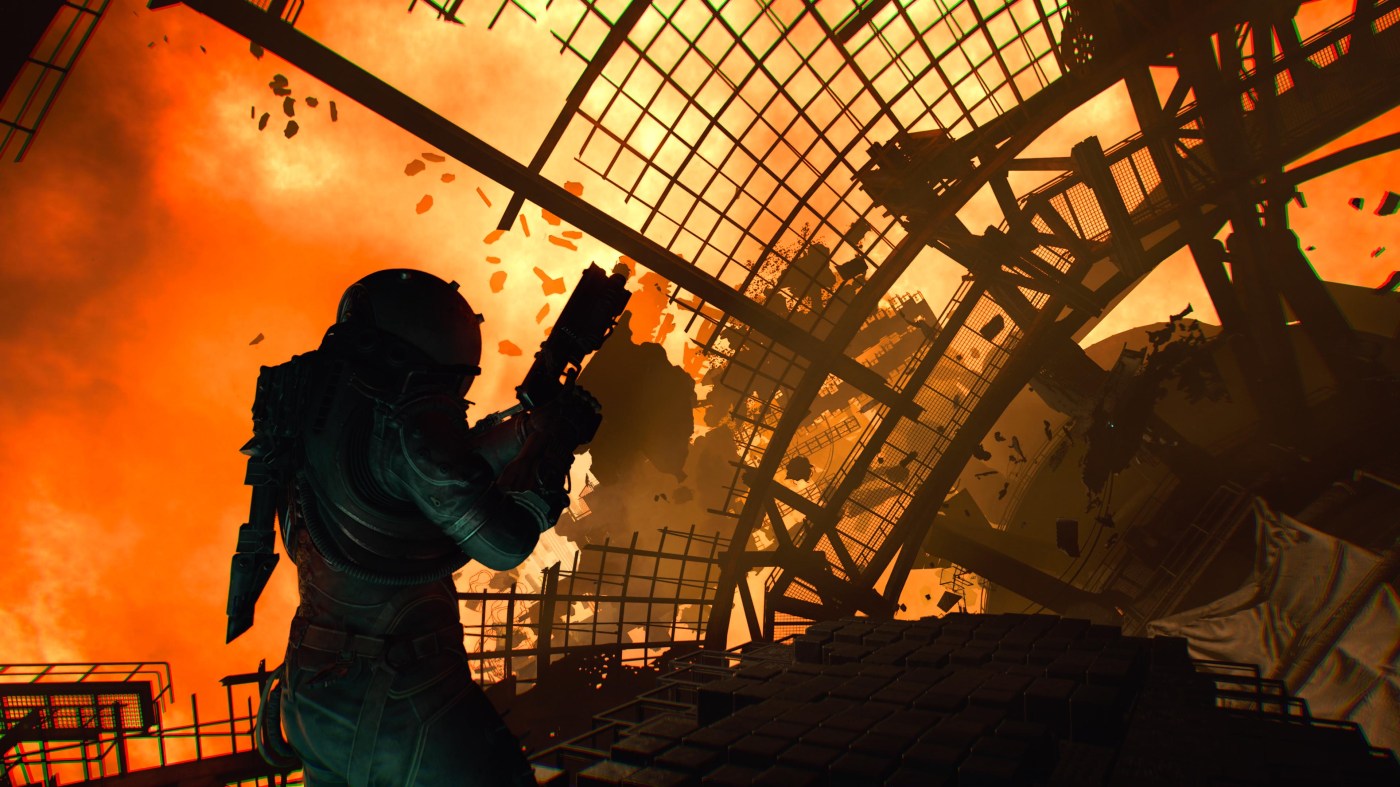
It wasn’t long ago that Polish studio Bloober Team were announced as the developers of a Silent Hill 2 remake, a fact that generated more than a few groans from folks let down by some of the team’s previous works. But not only did the studio absolutely exceed expectations with their rework of Konami’s 2001 classic, they have also managed to avoid becoming a one trick pony with Cronos: The New Dawn, which shows the studio bringing their newfound chops to an original time-hopping horror story.
With Cronos Bloober has crafted a unique 1980s sci-fi Poland that, like the rest of civilization, has been afflicted by a terrible infection that transforms humans into grotesque monsters called Orphans. But the game isn’t exactly set in the 1980s, not entirely. You actually play as a Traveler, a member of an unexplained organization called the Collective, which has sent you and other Travelers before you to this setting to “extract” specific people who did not survive the apocalypse. It’s all in service of a mission referred to as the Vocation, and there’s a devoutness with which Travelers carry themselves that underscores the gravity of the task, even as the game leaves many of its secrets unrevealed. They speak in weighty, considered tones, droning along in person and in spoken recordings and ending interactions with a customary “Such is our calling.”
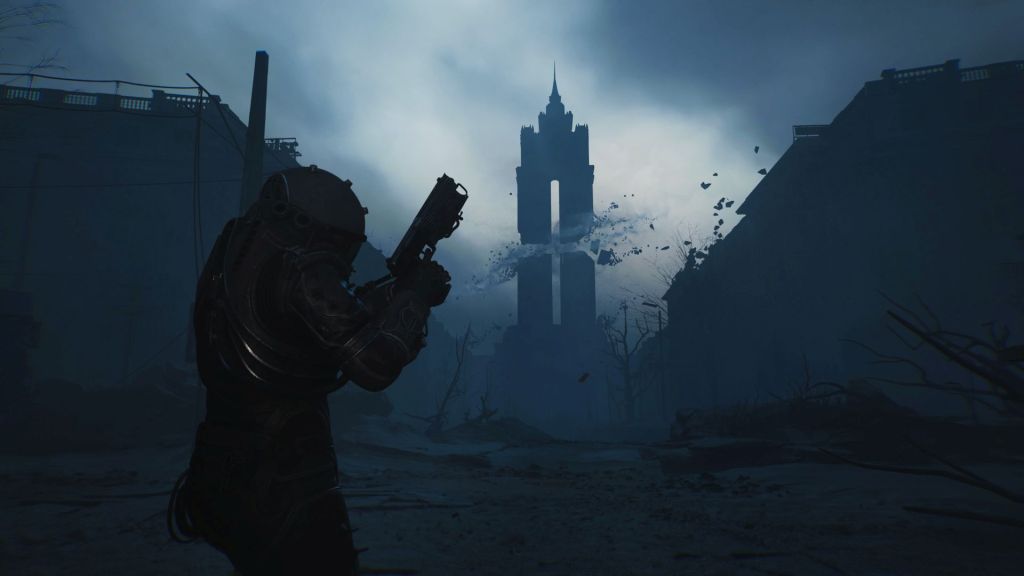
They also have the appearance of ocean divers of yesteryear, with bulky round helmets and suits that look like they’d survive an EVA in space. That’s because throughout the ruins of Poland are rifts that Travelers can “dive” into, sending them back in time to the outbreak so that they may carry out their extractions. Notably, these extractions do not involve rescuing these individuals from their terrifying predicament. Instead, the Travelers use a spidery metallic mechanism that stretches out from their glove, tendrils reaching for the target before a flash—and their “Essence” is pulled out, ready to be uploaded to the Collective. For precisely what reason? Who can say.
Much of the game’s story is told indirectly through letters and audio logs, one of a few things that makes Cronos feel like a throwback to the late aughts and early 2010s. There are a few conversations the Traveler gets into with the extraction targets that are especially weird and fragmented, as well as check-ins with a Collective point of contact called the Warden that are especially laborious and slow-spoken. These bits ended up being my least favorite part of the game’s storytelling.
Some of the Essences you gather are part of the critical path through the game, but there are a handful of others you can optionally take. Every Essence you carry grants a minor buff, but critically you can only carry three at a time. Any Essences you get rid of are lost forever. So over the course of the game you end up having to do away with certain buffs, which might force a slight change in strategy as you progress through the game. As you drag these unfortunate souls around they begin leaking into your own consciousness, and together with the game’s trophies/achievements that award you for extracting certain citizens I began to wonder what narrative details you might experience and miss depending on who you choose to carry around with you. The fact that these Essences all seem to thank you when you do release them in favor of someone else leads me to believe it’s not a pleasant journey.
Cronos is a linear game from start to finish, sitting neatly in that 12 hour completion range that works so well for these sorts of games. The Resident Evil and Dead Space influences are worn with the same subtlety as the freakish contraption that rips out people’s souls for the Collective. There are safe rooms with calming music and universal item boxes, a stomp button (distressingly underused, to be honest), aggressive inventory limitations, and difficult decisions to make about crafting and which weapon upgrade to acquire when you only have enough credits for one. The game even has its own “cut off their limbs” moment, wherein a letter found early on plainly states that you should set the enemies on fire, and traversal sections where you jump between different gravity points in a manner that is extremely reminiscent of the same mechanic from the first Dead Space.
Credit: GameRant
Combat in Cronos is intense thanks to a severely limited inventory that guarantees you’re hurting for ammo for most of the game. This will be a turn off for some, though I imagine those with a strong disliking of inventory management probably aren’t looking at a survival horror game anyway. Your available inventory slots can be upgraded, of course, but it wasn’t until the closing moments of the game that I reached a point where I actually felt well-stocked across the board. Your inventory space is so small in the first half of Cronos that sometimes you’re better off reloading a checkpoint if you miss more than a single shot during a combat encounter.
I didn’t find myself missing too many shots overall thankfully, in part because the Orphans you fight don’t shamble and sway quite as dramatically as Resident Evil’s zombies. They’re also not all that fast moving, giving you time to reposition when needed. I have to give the developers credit too for making it surprisingly easy to slip past enemies in tight quarters. There was more than one occasion where I became boxed in a corner by two or three monsters and assumed I was done for, but was totally able to thread the needle and escape without getting stuck on anything. One of the most maddening things that can happen in this type of game is becoming snagged on geometry or hit boxes (something I ran into a few times in the recent Resident Evil Requiem) and it never once happened here.
There are a handful of weapons in the game and it’s a pretty standard assortment. You’ve got your pistol, your shotgun, and your burst-fire rifle, and each of these have an upgraded variant that can be found (or missed, if you aren’t exploring thoroughly enough). The weapons have alternate firing modes, typically a charge shot that deals more damage. Since the charge shots don’t consume more ammo than a normal shot (and don’t have a particularly long wind-up either) it behooves you to just charge-shot all the time, in every fight. The combat can start to feel a bit repetitive after doing this for a few hours, but finding the different weapon variants can change things up.
Cronos puts a twist on combat with enemies that can absorb defeated monsters and take on their strength, and in some cases their abilities. An Orphan that spits corrosive acid can be absorbed by another foe, for instance, who will then be able to spit acid itself. The action takes a few seconds to complete so you’re given a chance to stop it, and it’s very important that you stop it because the upgraded Orphans can be a real pain to take down.
There’s a bit of variety to enemy designs, with some that crawl on ceilings, others that are massive and soak up damage, and some that sprout armor that deflects your shots. These ones in particular can be frustrating until you figure out where to shoot them, since you’re effectively wasting your precious ammo. And it isn’t immediately clear where you should be hitting them, since everything in this very dark and grimy game all looks… well, very dark and grimy.
I really enjoyed exploring the spaces in Cronos, ducking into nooks and crannies looking for crates to smash open for supplies and rescuing cats (!), who drop valuable items in exchange for scritches on the head. It’s a nice bit of levity in an otherwise oppressive game, one that is replete with gore and fleshy, squishy, pulsating membranes and viscera covering the walls. Unlike other genre staples there is no map of any kind in Cronos, forcing you to rely on your own spatial awareness and sense of direction to navigate twisting hallways and interconnected rooms. You can temporarily bring up a linear compass at the top of the screen with a button press that points you in the general direction of your objective, but I found this to be just unclear enough that I ended up not bothering to use it for most of the game.
Each area is well-designed, and it’s always so satisfying trudging through a hellish passage and finally unlocking a shortcut back to a safe room. There’s a hospital section in particular that feels like some good, classic Resident Evil level design. The only downside to moving through the world of Cronos is the spotty framerate, which can get pretty rough in particular areas. Not Blighttown levels of rough, but far below the 60FPS you get in other areas of the game.
In spite of some languid storytelling, Cronos really nails its Cold War-era sci-fi atmosphere. Its gritty, synth-soundtracked world is compelling and its combat is punchy enough to make its 12 hour runtime feel satisfying. Hats off to Bloober Team for contributing two solid games in a relatively short period of time to the survival horror landscape.
 Nate Andrews
Leave a comment